Product Positioning Strategy: What It Is, Examples, and How to Build Yours
What product positioning is, a six-step evidence-first process, a positioning map walkthrough, real examples from Textmagic and PostHog, and a fill-in statement template.
Summary of the article
Product positioning is the decision about who your product is for, what those buyers would use instead of it, and why yours is the better choice for them. It comes from customer evidence, not from a writing session. Market positioning analysis is the exercise where you test that decision against real competitors on a simple two-axis map.
Run the process in this guide and you walk away with three reusable outputs: a filled-in positioning canvas, a positioning map, and a one-paragraph positioning statement. Those outputs feed your website, your sales conversations, and your investor pitch.
- Positioning is a decision, not copy. Decide first, write second.
- Start from customers who already love the product, not from the market you wish you had.
- Your real competition includes doing nothing, spreadsheets, and manual workarounds.
- Pick the market category last, because it is the frame that makes your value obvious.
- An empty spot on a positioning map is a hypothesis, not proof that anyone wants it.
What product positioning actually is (and what it isn't)
April Dunford, who has worked on positioning with hundreds of technology companies, defines it in one sentence: positioning describes how a product is the best in the world at delivering something a well-defined set of customers cares a lot about. In her words, it answers the question "why us and not the other guys?" (Business of Software)
Four terms get mixed up constantly, so here is the split:
- Positioning is the internal decision about who you serve, what you replace, and what makes you different. It lives in a document, not on a billboard.
- Branding is the personality wrapped around that decision: name, look, tone.
- Messaging is the words you use to express the position across your website, sales pages, and ads.
- Market positioning analysis is the research exercise where you map your position against competitors using criteria buyers actually care about.
Positioning is the input. Branding, messaging, pricing pages, and sales conversations are outputs. When a website feels vague, the fix is usually upstream, in the positioning, not in the copy.
Why positioning comes before the pitch
Investors hear your positioning long before they hear your feature list. In the first two minutes of a meeting they are silently answering three questions: who is this for, what would these customers do without it, and why does this team win? If your positioning is foggy, the pitch inherits the fog no matter how polished it is.
The same is true for sales. A clear position tells a prospect which problems they should bring to you and which ones they shouldn't. That filtering is a feature, not a loss. A company that tries to sound relevant to everyone sounds specific to no one.
The evidence-first positioning process (six steps)
This process is adapted from Dunford's method, which she has published and taught openly, and which companies like Userlist have documented applying to their own repositioning (Userlist, Gavel). You can run it with two or three people in a week. Each step produces an output you keep.
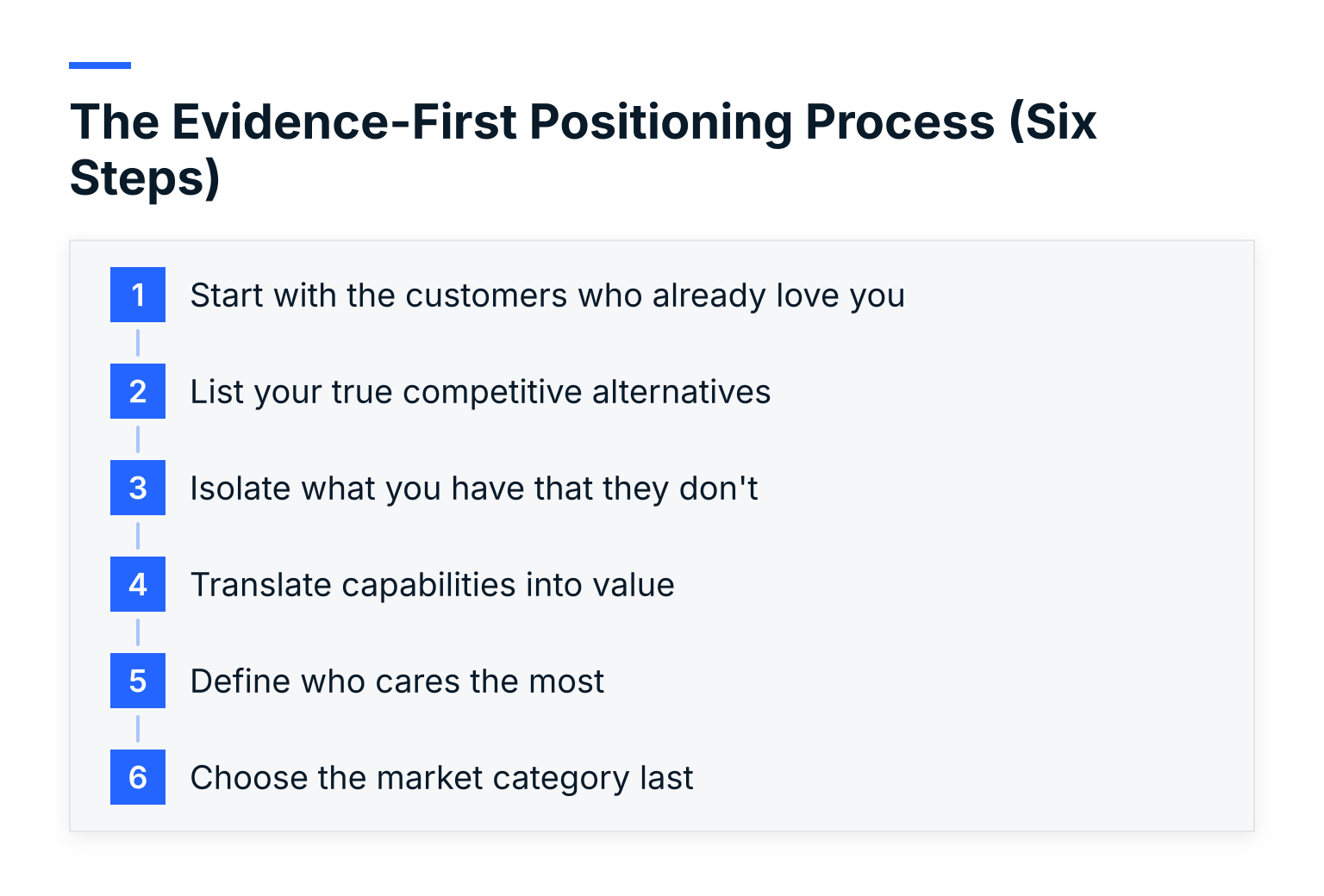
- 1.Start with the customers who already love you. Look at your best accounts: the ones who renew, refer, and rave. Interview two or three of them. Ask what they compared you against and what made them choose you. This is your raw evidence, and it matters more than any internal brainstorm.
- 2.List your true competitive alternatives. Not just named competitors. Ask: if we didn't exist, what would the customer do? The honest answers are often "use a spreadsheet," "hire someone to do it manually," or "do nothing." You have to beat those too. Userlist, for example, clustered their alternatives into four groups, including "build it in-house" and "follow up manually" (Userlist).
- 3.Isolate what you have that they don't. Make a big list of capabilities, then delete anything an alternative can also claim. If both you and the incumbent can say it, it's table stakes, not differentiation.
- 4.Translate capabilities into value. For each unique capability, ask "so what for the customer?" until you reach a business outcome. Then cluster the answers. Most products end up with two or three value themes. A fourth theme dilutes the rest.
- 5.Define who cares the most. Which customer characteristics make someone care intensely about that value? This is how you define your best-fit customer from the value outward, instead of guessing a segment from the industry inward.
- 6.Choose the market category last. Pick the frame of reference that makes your value obvious to the people you just defined. Category goes last because it's the only component you can judge once everything else is on the table.
The five-component positioning canvas
The process above fills in five blanks, plus an optional sixth. Write each one down; a positioning that lives only in a meeting room doesn't survive contact with next quarter.
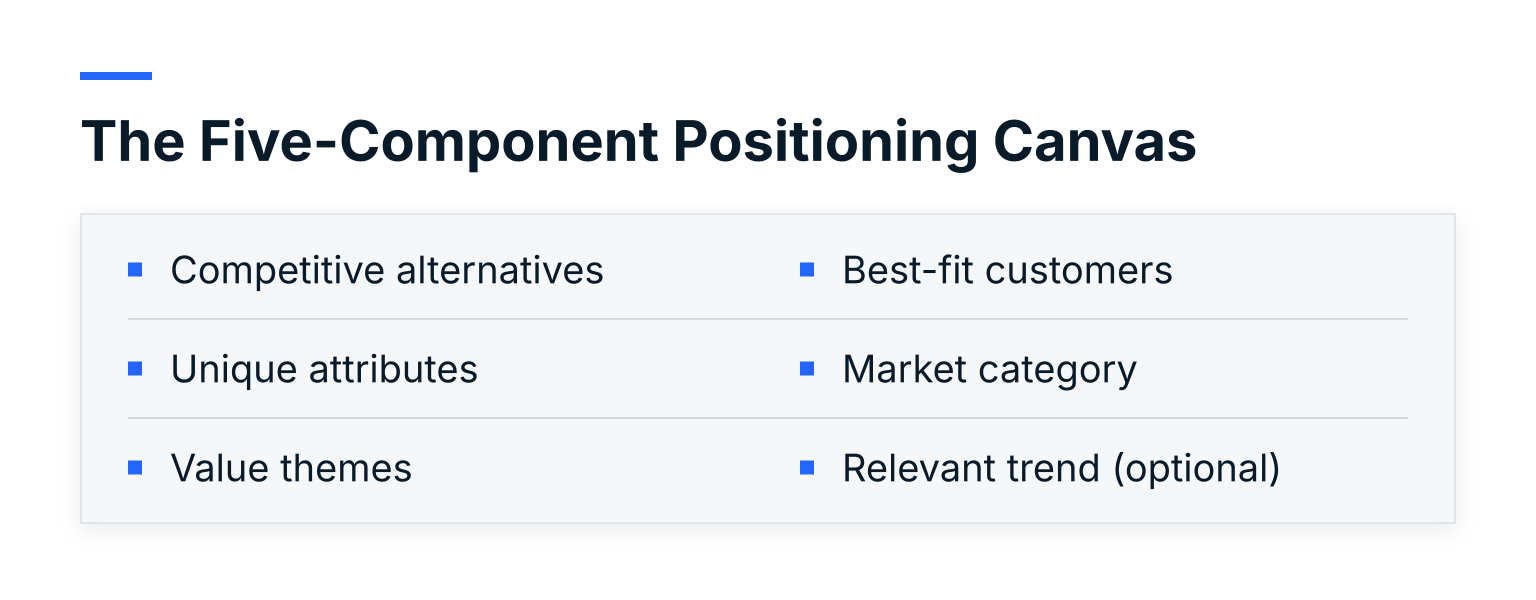
- Competitive alternatives: what the customer would do without you, including status quo workarounds
- Unique attributes: capabilities those alternatives genuinely lack
- Value themes: what those capabilities enable for the customer, clustered to two or three
- Best-fit customers: the characteristics that make a buyer care a lot about that value
- Market category: the frame of reference that makes your value obvious
- Relevant trend (optional): a real shift that adds urgency, only if it genuinely connects to your value
Three positioning strategies: head-to-head, small pond, or new game
Once the canvas is filled in, you choose one of three strategies. Dunford frames them as head-to-head, big fish in a small pond, and creating a new game.
Head-to-head means competing for an existing market on the terms buyers already understand. It works when you have a real advantage on a criterion the market values and the resources to press it. The trap is obvious: you're fighting incumbents on their turf, where they hold the trust, the integrations, and the budget.
Big fish, small pond means winning a subsegment of an existing market. This is the most practical option for most startups. Userlist is the textbook case: they first positioned as "email automation for SaaS" and kept getting compared to bigger, more feature-rich tools. They moved to "customer messaging for SaaS," named their subsegment, and even called out Intercom and Customer.io directly: "more efficient than building it yourself; less complex than Intercom or Customer.io." Nothing about the product changed, but prospects instantly understood what it was and who it was for (Userlist).
Create a new game means inventing a category. It's high risk and takes years of education. The upside is that you define the criteria buyers use to judge everyone, including yourself.
How to run a market positioning analysis
The analysis turns your positioning decision into something you can see and argue about. The method is simple:
- 1.Pick two buying criteria. These are the dimensions buyers actually use to choose, not the features you want to talk about. Examples: ease of setup versus depth of features, price versus service level, self-serve versus white-glove.
- 2.Plot five to ten competitors on those two axes, using evidence: pricing pages, reviews, sales call notes (Shopify).
- 3.Plot your company twice: where you think you are, and where customers probably perceive you today. The gap between those two points is where your positioning work lives.
Then read the map. Research firm Isurus classifies each criterion into zones that tell you what to do with it (Isurus):
- Own: criteria where you beat competitors. Lead with these.
- Cede: criteria where competitors are stronger. Stop arguing about them; you'll spend a fortune to reach parity.
- Open: criteria important to buyers that nobody serves well. A build opportunity, if you can hold the promise.
- Undervalued: strengths the market doesn't yet weight heavily. An education opportunity.
- Threshold: table stakes. You must clear them, but exceeding them wins you nothing.
One warning: if a quadrant of the map looks empty, that is not automatically an opportunity. It might be empty because no one wants that combination. Validate the gap with customer conversations before you build a strategy on it.
Worked examples: what good positioning looks like
Textmagic: positioning that changed with scope
Textmagic published its own positioning journey, which is rare and useful because they admit the first version wasn't final. Their early statement leaned on an "all-in-one platform" frame: "For businesses that need to engage with their customers across all channels, Textmagic is the all-in-one no-code platform that delivers performance at a fair price." Later, after deciding to narrow the product scope in their go-to-market phase, they rewrote it: "For SMBs looking to improve inbound and outbound communication, Textmagic is the budget-friendly alternative... with a lightweight, simple, AI-powered platform that is built for growth" (Textmagic).
The lesson isn't the wording. It's that positioning followed a real decision about scope, and it changed when the strategy changed.
PostHog: a product no category fits
PostHog does far more than product analytics: session replay, feature flags, A/B testing, data warehousing. No existing category name covers all of it. Calling themselves a "product analytics tool" would pigeonhole them against Mixpanel and Amplitude. Leading with a made-up category would confuse buyers. PostHog has repositioned more than once and documented it publicly, including how hard incremental repositioning is and why they decided to go "all in" on the new frame (PostHog).
This only works when you have the traffic and patience for it. Most startups should pick a category buyers already understand. The pattern worth copying from both examples: one claim, about one criterion, for one audience.
A positioning statement template you can fill in
Once the canvas is filled, compress it:
For [best-fit customer] who [need or job to be done], [product] is the [market category] that [key value]. Unlike [main alternative], we [unique difference].
Here's a made-up startup example to show the shape:
For clinic operations managers who still reconcile insurance claims by hand, ClaimPilot is the claims workflow tool that cuts reconciliation from days to hours. Unlike generic practice management suites, it validates every claim against payer rules before submission.
Notice what the statement forces you to decide: a specific buyer, a specific alternative, and one difference that matters. If you can't fill in a slot, you haven't finished the analysis. And if the whole thing can't shrink to one sentence for a pitch, that's a signal too.
Five mistakes that sink positioning
- Building on assumptions instead of interviews. If no customer conversation shaped your canvas, it's a hypothesis wearing a finished document's clothes. Talk to three happy customers before you write a word.
- Manufacturing a trend. A real trend adds urgency to value you already deliver. A borrowed one makes your positioning about the trend, and that's all the buyer remembers.
- Mixing frames across pages. Your homepage says one category, your sales pages say another, your ads say a third. Buyers can't build a memory of a position that keeps moving.
- Aiming at the user instead of the buyer. Products get positioned for the person who uses them, then fail because the person who signs the check cares about something else. If your win rate is confusing, this is a likely cause (You're Burning Runway Building for the Wrong Person).
- Writing positioning nobody operationalizes. If sales never uses the language, it doesn't exist. The symptom shows up downstream: meetings that feel great and never close (Why do our sales meetings go well but never close?).
Where positioning shows up next
A filled canvas makes several hard things easier. Your one-sentence pitch falls out of the market category and value themes, and if that sentence still won't come together, the problem is upstream in the positioning (Pitch It to Me in One Sentence). Your homepage hero, your pricing page framing, and your first sales call all inherit the same five answers. So does your investor story.
When to redo your positioning
Revisit the work when the inputs change, not on a calendar:
- You pivot or your product's scope changes meaningfully
- You enter a new market or a new geography
- Your win rate drops and sales can't explain why
- You're preparing to raise and the pitch feels like it's fighting you
Expect to redo it more than once. Userlist changed its positioning four times between 2017 and 2022, and PostHog has documented its own repositioning openly. Iteration is normal; treating the first statement as permanent is the mistake.
Positioning is where your investor story starts
Notice what the process produced: a clear answer to who buys, why they buy now, and how sales should position the product. Those are exactly the questions an investor asks, and exactly the questions a pitch has to answer in the first few minutes. When founders come to us with pitch problems, the root is very often upstream in positioning: the pitch is describing features because the underlying decision about audience, alternatives, and category was never made explicitly.
That's the work behind Pitch SHARP, our fundraising prep and pitch rework program, and it's also day-one work in a fractional CPO engagement, where product direction and go-to-market get defined together. If you've run this process and want a candid second opinion on where your positioning is thin before you take it to investors, request a call and we'll tell you plainly whether we're the right fit.