Startup due diligence checklist: what to review before you invest
By SHA/RP ·
A startup due diligence checklist by workstream: the documents to request, questions to ask, red flags, and how deep to go for the size of the deal.
Most due diligence checklists you find online are either a 40-page legal document list or a vague list of questions about vision and grit. Neither helps you decide whether to wire money. A useful checklist for due diligence is a working checklist, organized by workstream, that scales with the size of the deal and answers one question at each step: is this true, and can this team build it? This one covers investing in a startup, and shows where an acquisition changes the process. Adapt it to your deal.
The short version
A due diligence checklist works when you organize it by workstream, scope it to the deal, and give each workstream one owner. The core set covers entity and IP, founders and team, product, financials, customers and revenue, market, deal terms, and legal.
The trap to avoid: collecting documents is not the same as clearing items. A stack of PDFs tells you nothing until someone reads them against a question they can answer.
- Entity, IP and cap table: confirm the company actually owns what it sells.
- Founders and team: verify backgrounds and check key-person dependencies.
- Product: test what is built against what is claimed, and what the company owns versus licenses.
- Financials and customers: reconcile revenue to bank statements and talk to customers the founder did not pick.
- Deal terms and legal: model the round as it converts, and know what to hand to counsel.
How to use this checklist
Two decisions shape everything else.
1. Set the depth by deal stage and check size. A $25,000 pre-seed check justifies a lighter pass: cap table, IP assignments, a demo, a look at the numbers, two or three reference calls. A Series A check or an acquisition justifies the full list below. Depth should match what you are risking.
2. Assign one owner per workstream. If you are investing alone, you own all of them, but still work through them in order. If you are on a deal team, split the sections and set a date for each to report back. Unowned sections do not get done.
Keep the due diligence list short enough that someone will actually read what arrives. A workable sequence for any deal:
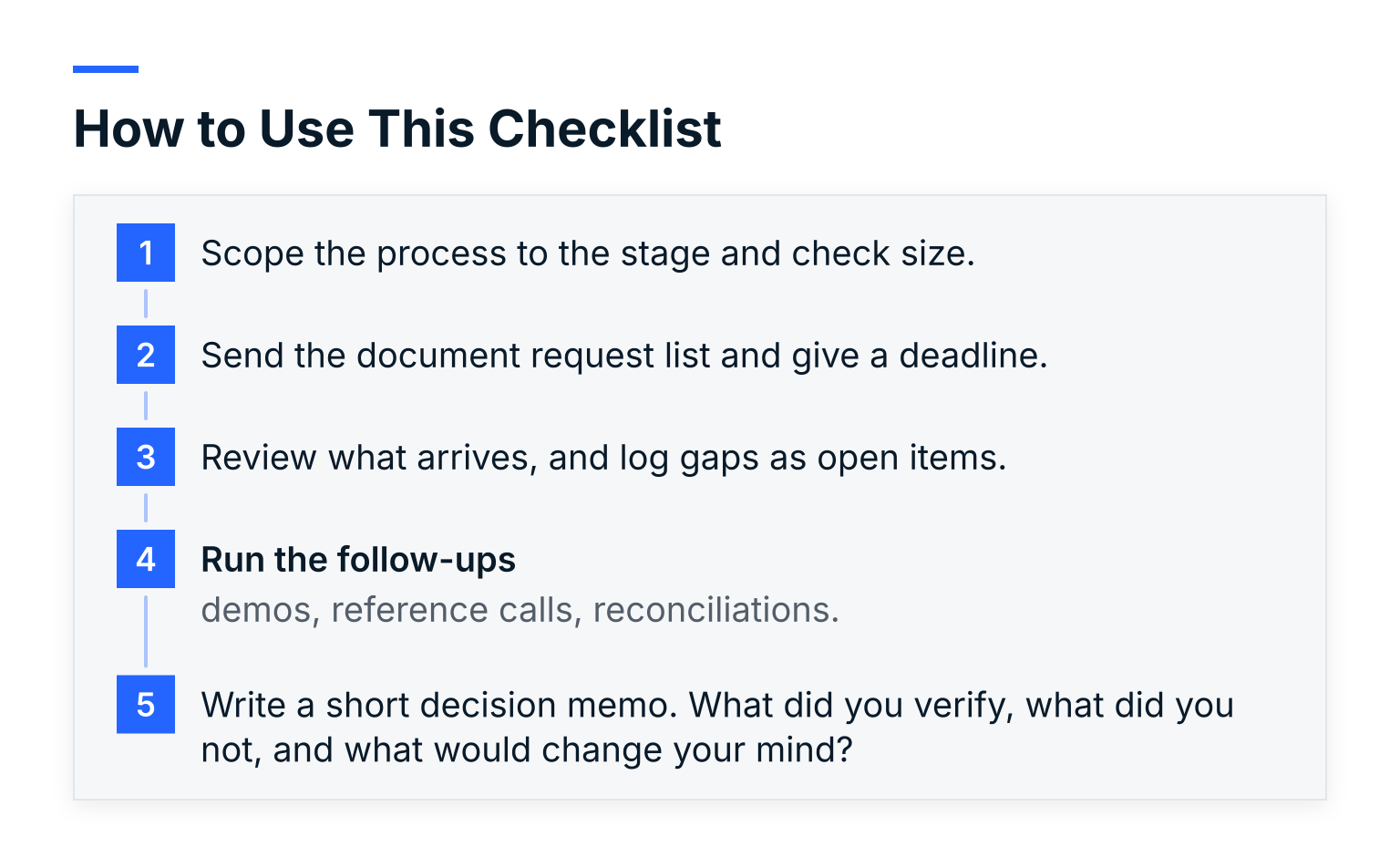
- Scope the process to the stage and check size.
- Send the document request list and give a deadline.
- Review what arrives, and log gaps as open items.
- Run the follow-ups: demos, reference calls, reconciliations.
- Write a short decision memo. What did you verify, what did you not, and what would change your mind?
Entity, IP and cap table
This section answers a blunt question: does the company actually own the thing it is selling you a share of?
Documents to request
- Certificate of incorporation and every amendment, plus bylaws
- Fully diluted cap table, tied to signed grant and purchase documents
- Signed IP assignment agreements from every founder, employee, and contractor who touched the product, including work done before incorporation
- Group structure chart, if there are multiple entities
- Prior financing documents: SAFEs, notes, side letters
Questions to ask
- Who built the first version of the product, and did they sign an assignment? A missing contractor signature is one of the most common gaps in early-stage deals.
- Are there any promised but undocumented equity grants? Offer letters and casual promises count.
- Do any universities, prior employers, or governments have a claim on the core technology?
Founders and team
Resumes the founder wrote tell you how the founder writes resumes. Verification means sources the founder did not write.
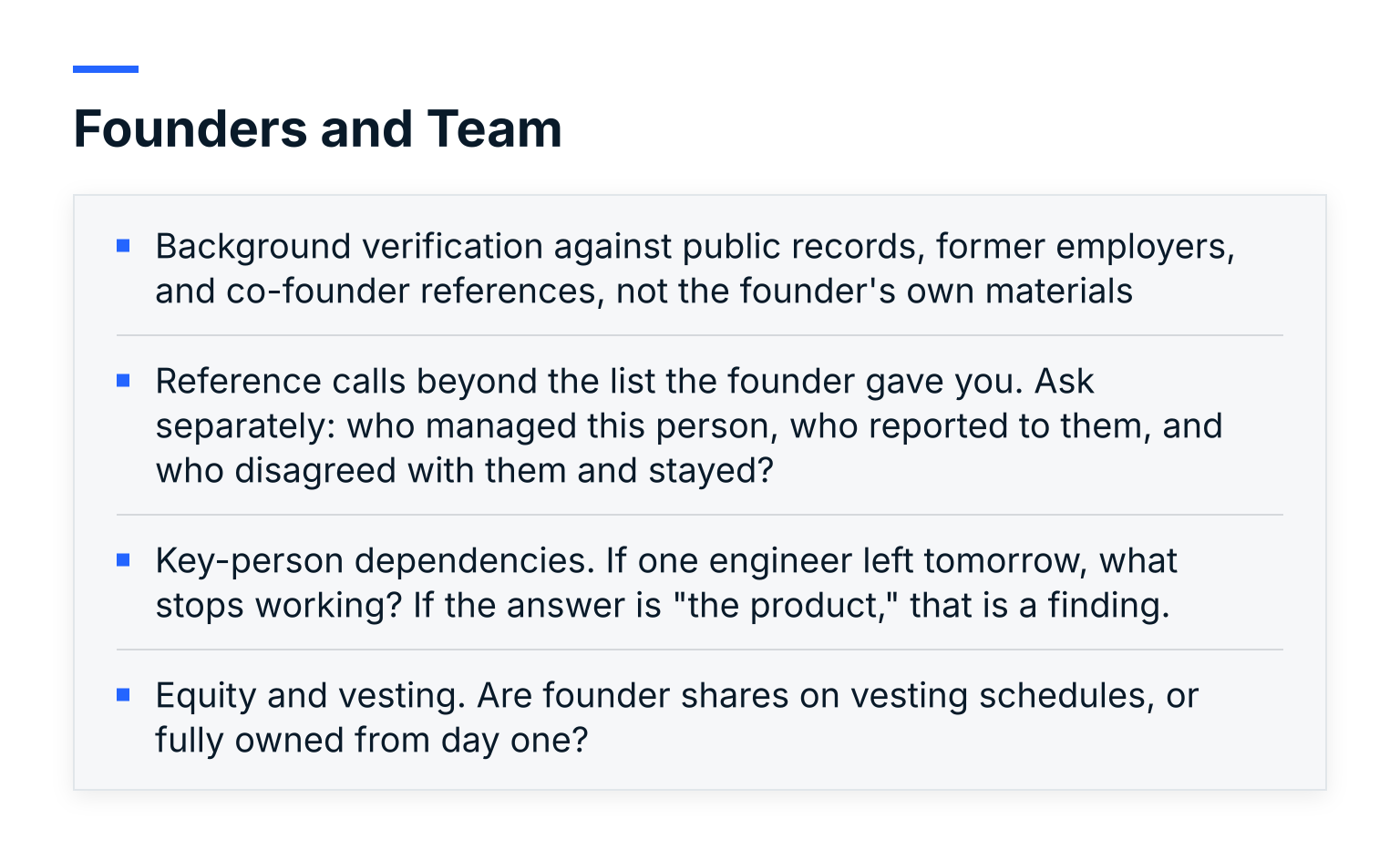
- Background verification against public records, former employers, and co-founder references, not the founder's own materials.
- Reference calls beyond the list the founder gave you. Ask separately: who managed this person, who reported to them, and who disagreed with them and stayed?
- Key-person dependencies. If one engineer left tomorrow, what stops working? If the answer is "the product", that is a finding.
- Equity and vesting. Are founder shares on vesting schedules, or fully owned from day one?
Product due diligence
This is the workstream generic checklists skip, and it is often the one that decides the deal. Technical and commercial diligence can both look clean while the product is not what the pitch says it is. Three questions drive this section.
Built versus claimed. Ask for a live demo run by the technical founder, not a recorded pitch video. Watch what happens when you ask for something off script. A recorded demo proves someone edited a video. A live session proves someone built a thing.
Owned versus licensed. Map what the product actually depends on: proprietary code, third-party APIs, licensed datasets, model providers. If the core capability is a wrapper on someone else's API, the question becomes what happens to margins and differentiation when that provider changes pricing or terms.
What data or moat the company actually owns. Proprietary data, network effects, and switching costs are real moats when you can see them. Ask to see the data asset, the retention numbers behind the network, or the integration depth that makes switching expensive. "Moat" as a pitch word is not a moat.
This section is where funds with product questions but no product team in the room get stuck. That is the gap SHA/RP's pre-fund product due diligence fills for VC funds: a product-side review of exactly these questions before you close. If you sit on a deal team, see how that work is framed in SHA/RP for funds. For how diligence fails when findings land without anyone able to evaluate them, read The Due Diligence Room.
Financials
At pre-seed, this is short. By Series A, reconcile everything.
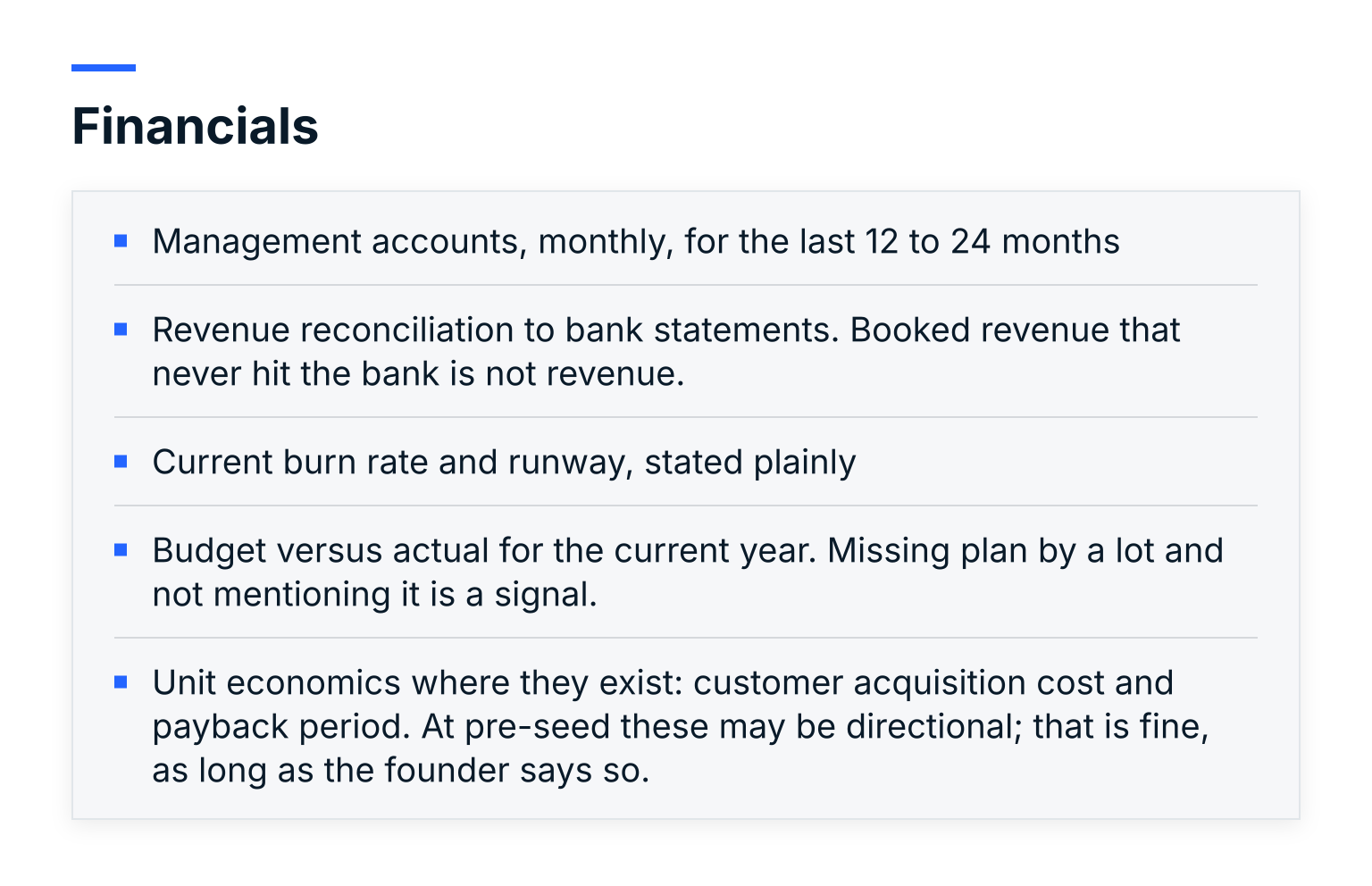
- Management accounts, monthly, for the last 12 to 24 months.
- Revenue reconciliation to bank statements. Booked revenue that never hit the bank is not revenue.
- Current burn rate and runway, stated plainly.
- Budget versus actual for the current year. Missing plan by a lot and not mentioning it is a signal.
- Unit economics where they exist: customer acquisition cost and payback period. At pre-seed these may be directional. That is fine, as long as the founder says so.
Customers and revenue quality
Revenue figures hide concentration, churn, and the difference between a pilot and a contract. Pull them apart.
- Revenue concentration: what share of revenue do the top three customers represent?
- Pilots versus signed contracts. A pilot with an option to buy is not revenue. It is a test.
- Churn and retention by cohort, not blended averages. A blended number can hide a cohort that never renewed.
- Customer references, including at least one the founder did not pick. Take the founder's references, then pick your own names from the customer list and call customers who churned or downgraded. Churned customers answer the question references never do: why did they leave?
Market and alternatives
- Bottom-up market sizing: number of reachable customers times what each pays per year. Top-down numbers of the form "1% of a $50B market" are not sizing. Pear VC's market sizing guide shows the bottom-up build investors actually test.
- The real competitor. For most products it is not the startup named in the pitch's comparison. It is a free feature in an incumbent product, a spreadsheet, or the status quo. Ask: what do the target's current customers do today instead?
Deal terms
Terms can quietly change what you are buying. Check:
- Round label versus actual price. A "$10M seed" is a marketing number until you see the price per share.
- SAFE caps and conversion modeling. Y Combinator's SAFE documentation explains caps, discounts, and pro-rata rights in plain terms. Model the outstanding SAFEs as if converted before you agree to your percentage.
- Option pool dilution. A pool increase agreed in the pre-money valuation comes out of existing holders, so check who pays for it.
- Pro-rata and information rights. What can you actually maintain and see after this round?
Legal and regulatory
You are not the lawyer. Your job here is triage: know what to flag for counsel and what you can check yourself.
Flag for counsel: pending or threatened litigation, required licenses and permits, open-source license obligations in the codebase, export-control exposure, employment classification of contractors.
Check yourself: whether the entity structure matches where revenue comes from, whether prior round documents contain rights you are about to inherit or violate, and whether anything in the data room contradicts what the founder told you.
Red flags, and how diligence actually fails
Red flags worth slowing down for:
- Documents arrive but questions go unanswered. A complete data room with no reconciliation to anything is a performance, not diligence.
- The founder resists a live product demo or a churned-customer reference.
- Revenue that reconciles to invoices but not to the bank.
- The cap table does not match signed grant documents.
- Every competitor comparison shows the company winning.
The deeper failure is structural: a folder full of findings that nobody on the deal team can evaluate. Legal counsel reviews the contracts, finance reviews the accounts, and the product claims pass through untouched because no one owns the question "can this team build what they are selling?" Give the product workstream to someone who can actually run it.
What changes for an acquisition
An acquisition due diligence checklist adds weight in places a seed check barely touches:
- Full financial audit history and tax exposure, not management accounts.
- Every material contract, checked for change-of-control clauses. Some customer and vendor contracts terminate on acquisition, which can change the deal's value overnight.
- Employment liabilities, benefits obligations, and pending disputes.
- Deeper IP review: registrations, licenses in and out, and freedom to operate.
- Regulatory and compliance review at a depth that matches the liability you inherit.
For a full legal document list at acquisition depth, Bloomberg Law's M&A due diligence checklist runs to well over a hundred document types. The product workstream matters even more here: in an acquisition you are buying the thing itself, and "built versus claimed" becomes "what exactly are we paying for, and who on our side can maintain it?"
Frequently asked questions
How deep should due diligence go at pre-seed?
Match it to the check. For a small pre-seed check, the entity, IP, cap table, a live demo, a look at the numbers, and a few reference calls are usually enough. Write down what you did not check, so you know what you are accepting.
Who should run each workstream?
One named owner per workstream. On a fund deal team, legal takes entity and regulatory, finance takes financials, a partner or analyst takes commercial and customers, and someone with product judgment takes the product review. Solo angels do the sections in order and keep the product section honest by watching a live demo.
Is an acquisition checklist different from an investment checklist?
Yes, mainly in financial, legal, and contract depth. Acquisitions inherit liabilities, so audits, tax, change-of-control clauses, and regulatory exposure get much heavier. The core workstreams stay the same.
What is the single most skipped check?
The live product demo run by the technical founder. It is cheap, fast, and it tests the claim every other document is built around.
Next step
If you are evaluating a startup and the product workstream is the part nobody on your side can fully run, request a call about SHA/RP's pre-fund product due diligence. If you are a founder preparing for the other side of this process, the free tools include a Pitch Check built around the questions investors actually ask.
Related: Pre-fund due diligence
For the deal seat: an outside read on whether the team can build the right thing, inside your diligence window.
Pre-fund due diligenceRead next
- The Due Diligence Room
The security was fine. The problem was that no one in the room could explain it in terms the investor could evaluate.
- Fear is Information. Danger is a Measurement.
Most people treat the feeling as if it's the measurement. It isn't. Fear is a signal. Risk is something you measure with data.
- What CEOs Say About Security (And What It Means)
9 out of 10 founders I work with are either overpaying, underprotected, or both. Not because they didn't try. Because the industry is not structured to tell them the truth.