What does a go-to-market consultant do (and when should you hire one)?
A candid explainer: what a go-to-market consultant actually does, the signals a startup needs one, when it's too early, and how to choose between a consultant, fractional GTM leadership, and an in-house hire.
The short version
A go-to-market (GTM) consultant finds out why your startup isn't selling consistently, then designs the fix: a clear picture of who buys and why, positioning and messaging that match, the right channels, and a repeatable pipeline you can measure. It works best when you have real customers and deals but can't make the motion repeat. It works badly, or is wasted money, before product-market fit, or when your real problem is execution discipline or a missing internal owner rather than strategy.
The decision comes down to three constraints:
- Strategy and system: something is genuinely unclear or broken in how you sell. A consultant fits.
- Capacity: the strategy is fine but nobody senior has time to run it. Fractional GTM leadership fits better.
- Leadership: you need someone with authority to own product and GTM decisions for months, not a project. Hire in-house, or a fractional CPO with GTM responsibility.
The short answer
A go-to-market consultant is an outside expert who diagnoses why your product isn't winning customers consistently, then designs and often helps build the system that fixes it. Go-to-market is everything between "we have a product" and "we have predictable revenue": who the product is for, what the message is, which channels you use, how sales runs, and how you measure all of it.
The honest version of the job is less about producing a strategy document and more about removing guesswork. By the end of a good engagement you should know who buys, why they buy now, what to say, where to reach them, and how to tell next quarter whether it's working.
If you want the broader context first, Stripe's GTM guide for startups gives a solid plain-language overview of what a go-to-market strategy covers.
What a GTM consultant actually works on
The work concentrates on five areas. Most startups hire because more than one of them is broken at the same time.
Ideal customer profile and buyer clarity. Pinning down who actually buys, what triggers the purchase, and who else has to say yes. In B2B, the person who uses the product is often not the person who signs the cheque. When those two get confused, marketing speaks to one and sales pitches to the other, and neither converts. We've written about this pattern in detail: you're burning runway building for the wrong person.
Positioning and messaging. Deciding what the product is, who it beats, and why a buyer should switch. This is where consultants earn their fee most visibly, because a sharp positioning statement changes every email, demo and landing page downstream.
Channel strategy. Choosing the two or three ways you'll actually reach buyers, and dropping the rest. Most early-stage companies don't need every channel; they need one that works reliably.
Launch and pipeline execution. Turning the plan into a working motion: outreach sequences, a sales process with defined stages, CRM hygiene, and handoffs between marketing and sales.
Measurement. Defining which numbers matter, so you can tell whether a channel produces qualified pipeline or just activity.
What an engagement usually looks like
Engagements differ. Some consultants run fixed-scope projects, others work fractional over months, some operate as small agencies. But most follow the same arc:
- 1.Diagnose. Review your deals, win/loss notes, CRM data, messaging and channels to find the actual constraint. Not what the team assumes is broken; what the evidence says is broken.
- 2.Design. Define the ICP, positioning, channel plan and pipeline targets.
- 3.Build. Implement: playbooks, sales stages, tracking, first campaigns.
- 4.Measure and adjust. Run the motion, check the numbers, fix what underperforms.
A useful test happens in step one. Ask a candidate consultant what they'll do in the first two weeks. If the answer is a diagnosis, that's a good sign. If the answer is a template they apply to every client, you're buying paperwork.
Signals that you actually need one
Multiple practitioners converge on the same set of warning signs. You don't need all of them. Two or more is a strong case:
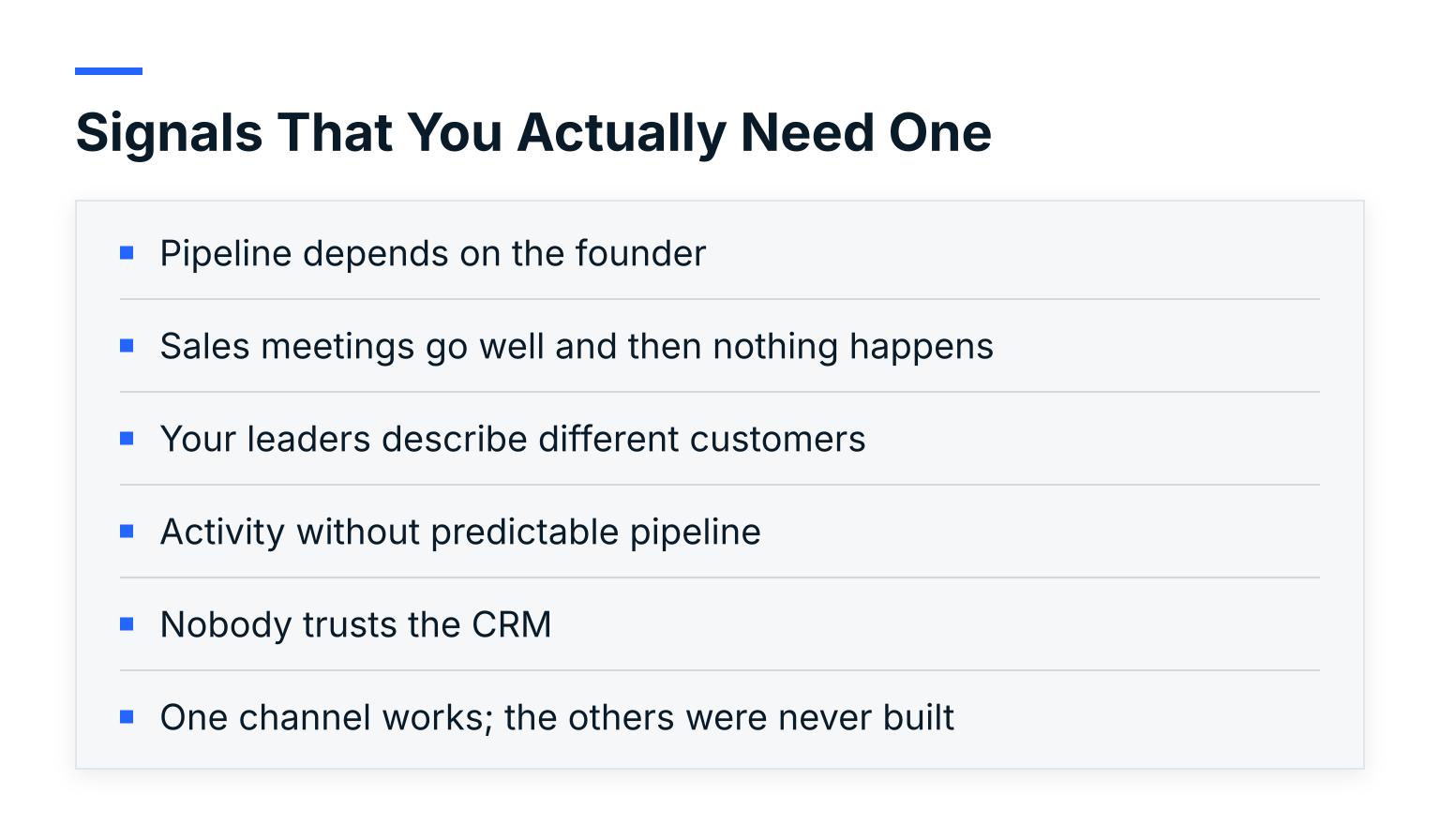
- Pipeline depends on the founder. Most deals trace back to your network, your calendar, or your personal charm. That works until you need to grow faster than you personally can sell.
- Sales meetings go well and then nothing happens. Deals stall at the same stage repeatedly, and nobody can say why. We wrote a separate piece on why sales meetings go well but never close.
- Your leaders describe different customers. Ask the founder, the sales lead and the product lead who the buyer is. If you get three answers, positioning is missing, not just under-communicated.
- Activity without predictable pipeline. Campaigns run, content ships, but nobody can say which activity produces qualified opportunities or forecast next quarter.
- Nobody trusts the CRM. Duplicate accounts, stages nobody agrees on, a forecast that's fiction.
- One channel works; the others were never built. Strong inbound with no outbound, or the reverse, and no plan to change that.
When a GTM consultant is premature
Before product-market fit, a GTM consultant is usually too early. The problem is simple: with too few closed deals, there's nothing to diagnose. A consultant can't derive a repeatable motion from three customers and a hunch; you'd be paying for confidence, not evidence.
Pre-PMF, the work is validation: narrow target segment, lots of customer conversations, small cheap experiments. Balderton's Founders' Guide to B2B Sales is a good free resource on this stage. If you're not sure whether you have product-market fit, treat the honest answer as no and validate first. Our guide to what product-market fit is and how to tell if you have it covers the tests.
When it's not a consultant problem
Some problems look like GTM problems but aren't, and hiring a consultant for them wastes money:
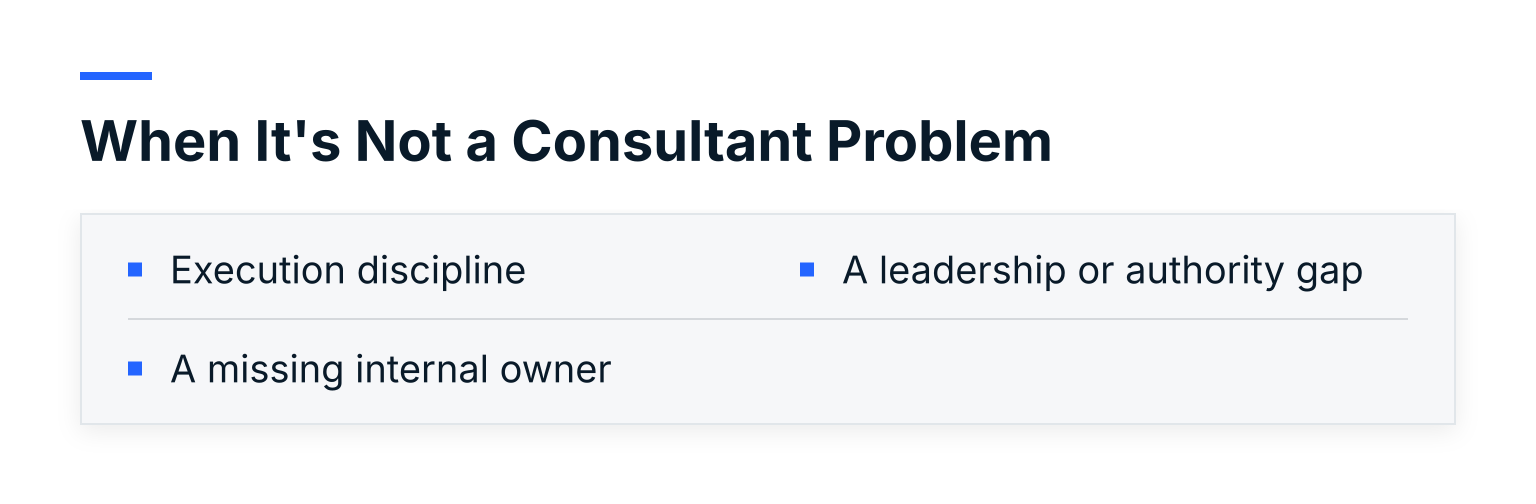
- Execution discipline. The plan exists and is reasonable; the team just doesn't follow it. Another document won't fix that.
- A missing internal owner. Nobody is accountable for GTM day to day. A consultant can design the system, but someone inside has to run it. If no such person exists or can exist soon, that's a hiring problem first.
- A leadership or authority gap. Sometimes the constraint is that product and commercial decisions have no senior owner with the authority to make them stick. Adding outside advice doesn't create that authority.
A candid consultant will tell you when your problem is one of these. A consultant who never does is selling a template.
Consultant vs fractional GTM leader vs full-time hire
The real decision is usually not "consultant or nothing." It's which engagement model matches your constraint:
| Consultant (project) | Fractional GTM / CPO leader | Full-time in-house hire | |
|---|---|---|---|
| Best when | A specific strategy or launch problem needs solving | You need senior ownership of product + GTM for months, without a permanent hire | You have steady, high-volume GTM and product work |
| What you get | Diagnosis, plan, sometimes implementation help | Decision-making and execution inside the company, part of your team | Permanent capacity and continuity |
| Ownership | Low: delivers advice and artefacts | High: accountable for outcomes while engaged | Highest: it's their company role |
| Continuity | Ends with the project | Ends at handoff, ideally to a permanent hire | Stays |
| Commitment | Fixed scope, short | Part-time, mid-term | Full salary, full-time |
A project consultant is right when the problem is bounded: a launch, a repositioning, a channel decision. A fractional leader is right when the problem is ownership: you need someone senior making product and GTM decisions week after week while you hire permanently. A full-time hire is right when the workload justifies it and the strategy is already clear enough to hand over.
This is where we declare our own position plainly: SHA/RP provides fractional CPO and go-to-market leadership for startups, including defining product direction and GTM strategy and clarifying who buys, why they buy now, and how sales should position the product. It's the fractional-leadership path in the table above. We also wrote a dedicated guide on how to find the right fractional CPO, and when not to hire one, because this choice deserves the same scrutiny as any hire. You can read more about our fractional CPO and go-to-market work for startups.
How to evaluate a GTM consultant
Three checks cut through most sales pitches:
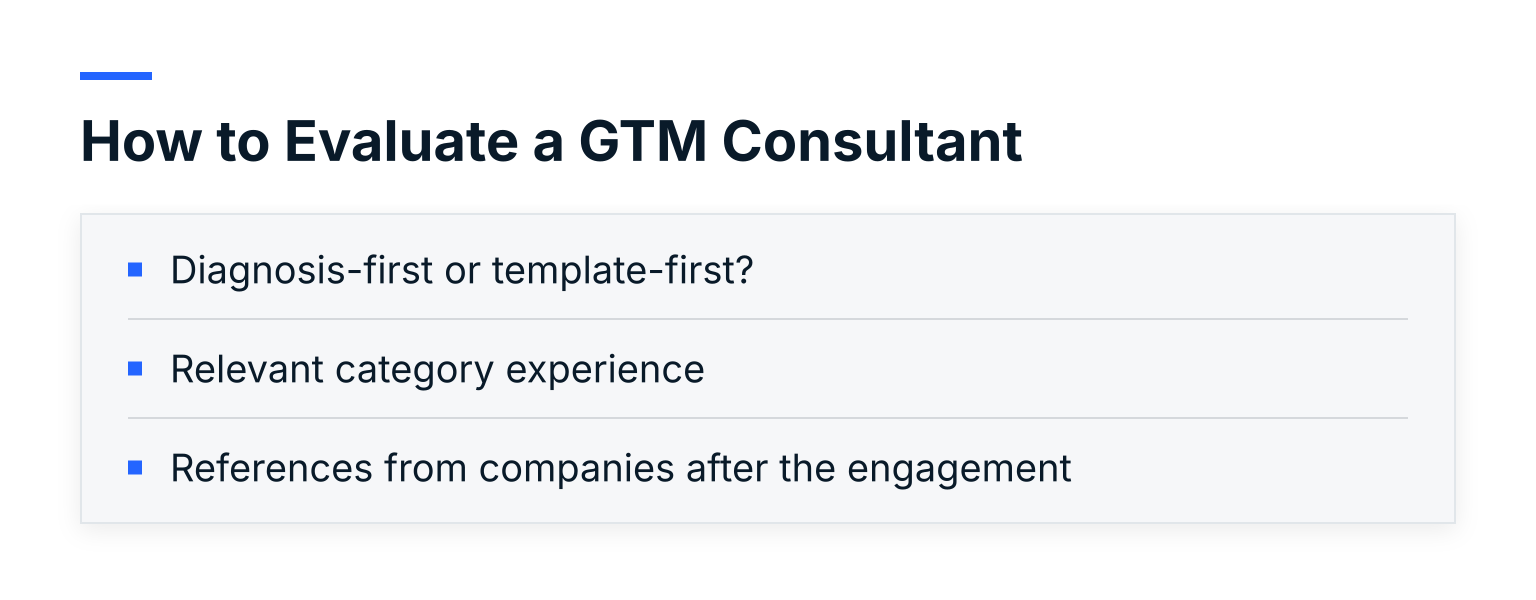
- Diagnosis-first or template-first? Ask what they'd need to see in the first two weeks and what would change their recommendation. A real diagnostician has answers. A template-seller already knows your answer before meeting you.
- Relevant category experience. Have they worked with companies like yours, selling to buyers like yours, at your stage? Enterprise GTM experience doesn't automatically transfer to self-serve SaaS, and vice versa.
- References from companies after the engagement. Not testimonials on the website. Talk to two former clients and ask what changed, what didn't, and what they'd do differently.
What to expect as outcomes
Set expectations before signing. A good engagement produces, roughly in order:
- 1.A diagnosis of the real constraint, in writing, with evidence.
- 2.A prioritized plan: ICP, positioning, channels, pipeline targets.
- 3.A working system: sales stages, tracking, first campaigns actually running.
- 4.Evidence for the next hire: a clear picture of what a full-time GTM or product leader should own, which makes your eventual in-house hire dramatically better specified.
If a proposal promises revenue numbers before diagnosis, walk away. No honest consultant can promise a conversion rate they haven't measured.
The decision, simply
If you have real customers but no repeatable motion, and the gap is strategy or system: hire a GTM consultant for a bounded engagement. If the gap is senior ownership of product and GTM over months: a fractional CPO with GTM responsibility is usually the better tool, and cheaper than a wrong full-time hire. If the workload is real and steady: hire in-house. And if you're pre-product-market fit: validate first, spend later.
If you want to talk through which constraint is yours, request a call and we'll tell you whether fractional CPO and go-to-market leadership is the right fit. You can also browse our free tools for founders in the meantime.