Product Strategy Template: A Simple Framework for Startups
A copyable one-page product strategy template for startups, with field-by-field guidance: diagnosis, buyer clarity, bets with kill criteria, and roadmap translation.
Summary of the article
A product strategy template is a one-page structure you fill in that forces the decisions a feature list hides: what is true today, who buys and why now, which bets you are making, what would kill each bet, and what you will not do. This article gives you a copyable template plus field-by-field guidance on what good and bad entries look like.
- Diagnosis: facts and numbers about where you stand, not hopes.
- Buyer: the person who signs, not the person who uses.
- Bets: 3 to 5, each with a hypothesis, evidence, and a kill condition.
- Non-goals: what you are deliberately saying no to, even when it costs you deals.
- Priorities and measures: outcomes with a baseline, a target, and an owner, limited to real team capacity.
If you fill this in and every field passes a skeptical investor's read, you have a strategy. If any field collapses into buzzwords, that field is your actual problem.
What a product strategy template should contain
A product strategy answers one question: given where we actually are, which few things will we do, and which will we refuse to do? A template is useful because it forces you to write those answers down in an order that exposes weak thinking early.
For a startup, the template should be small enough to hold in your head. The version below has seven numbered sections plus a review cadence block:
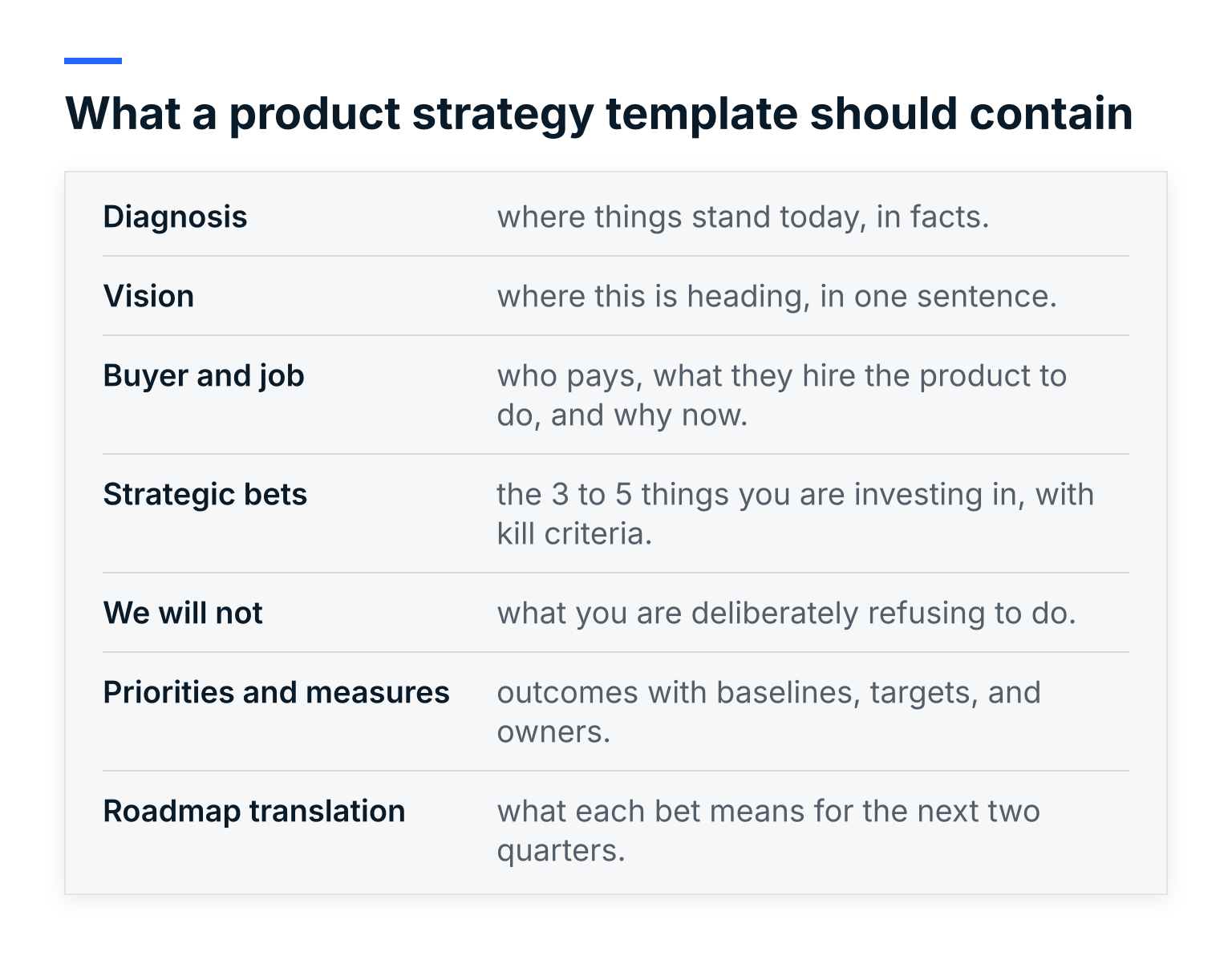
- 1.Diagnosis: where things stand today, in facts.
- 2.Vision: where this is heading, in one sentence.
- 3.Buyer and job: who pays, what they hire the product to do, and why now.
- 4.Strategic bets: the 3 to 5 things you are investing in, with kill criteria.
- 5.We will not: what you are deliberately refusing to do.
- 6.Priorities and measures: outcomes with baselines, targets, and owners.
- 7.Roadmap translation: what each bet means for the next two quarters.
That structure is close to what other public templates cover. Asana's product strategy template organizes vision, personas, priorities, and success metrics into one plan, and Product School's version walks through vision, insights, and challenges before execution. Tability's product strategy template goes further, with a full worked example and downloadable files. The difference here: each field comes with candid guidance on what a good entry actually looks like, and the template comes to your inbox as a two-page PDF, ready to work through with your team.
The fill-in template
Here it is. It is deliberately short, but it is not a form to fill in on the spot: the diagnosis needs real numbers, and the bets need your team in the room. Get it as a PDF below, print it or share it, and work through it together.
PRODUCT STRATEGY
Horizon: [12 months]
Last reviewed: [date] | Next review: [date]

1. DIAGNOSIS
Where we stand today (facts and numbers, no aspiration):
- [e.g. 120 paying customers, $8k MRR, 6% monthly churn]
- [e.g. 70% of revenue comes from one industry]
- [e.g. 2 of 5 engineers' time goes to custom customer requests]

2. VISION
In one sentence, what is true when this strategy has worked:
[...]

3. BUYER AND JOB
- Who signs the invoice: [role, company size, industry]
- Who uses it daily: [role, if different]
- The job they hire us for: [...]
- What they use today instead: [competitor, spreadsheet, or nothing]
- Why now: [what changed that makes this urgent]

4. STRATEGIC BETS (3-5)
For each bet:
- Bet: [...]
- Hypothesis: We believe [action] will produce [measurable outcome]
- Evidence so far: [...]
- Kill criteria: [observable condition that stops this bet]

5. WE WILL NOT
- [Something a reasonable colleague would argue for]
- [Something that costs us real deals or revenue]

6. PRIORITIES AND MEASURES
For each priority (max 3):
- Outcome: [measure]
- Baseline: [today's number] → Target: [number by date]
- Owner: [one named person]

7. ROADMAP TRANSLATION
For each bet: what ships or gets tested in the next 2 quarters.

REVIEW CADENCE
What would change this strategy: [observable conditions]
Reviewed: [monthly/quarterly], changes logged.
Notice that kill criteria and a review cadence are part of the template, not an optional extra. Tability's public template makes the same move: its guidance tells you to record the evidence you already have and the result that would make you stop, because "a bet without a kill condition is a roadmap item." A template that lets you write bets with no stopping conditions is not doing its job.
Field by field: what good looks like
Diagnosis: facts, not hopes
The diagnosis is where most strategies fail before they start. A good diagnosis reads like a status report from someone who is slightly annoyed with the truth: "We have 40 paying customers, churn is 5% a month, and 60% of engineering time goes to one enterprise client's custom requests."
A bad diagnosis reads like a sales brochure: "The market is exploding and our product is uniquely positioned." Neither sentence tells you anything you can act on or prove wrong.
The test: every line in your diagnosis should be a number, a named problem, or a verifiable fact. If a sentence would embarrass you in front of an investor, it is probably honest enough.
Buyer and job: who signs is not who uses
The template asks for the buyer and the user separately on purpose. In many B2B products they are different people with different objections, and building for the user while ignoring the buyer is a common way to burn runway. We cover that failure mode in You're Burning Runway Building for the Wrong Person.
"Why now" matters more than founders expect. If nothing has changed, the buyer has no reason to change tools this quarter. Good answers name a shift: a regulation, a price change, a new workflow, a competitor retreat. If you cannot answer why now, your buyer field is probably too broad.
Strategic bets: a bet without a kill condition is a roadmap item
A strategic bet has three parts: a hypothesis, evidence you already have, and a kill condition.
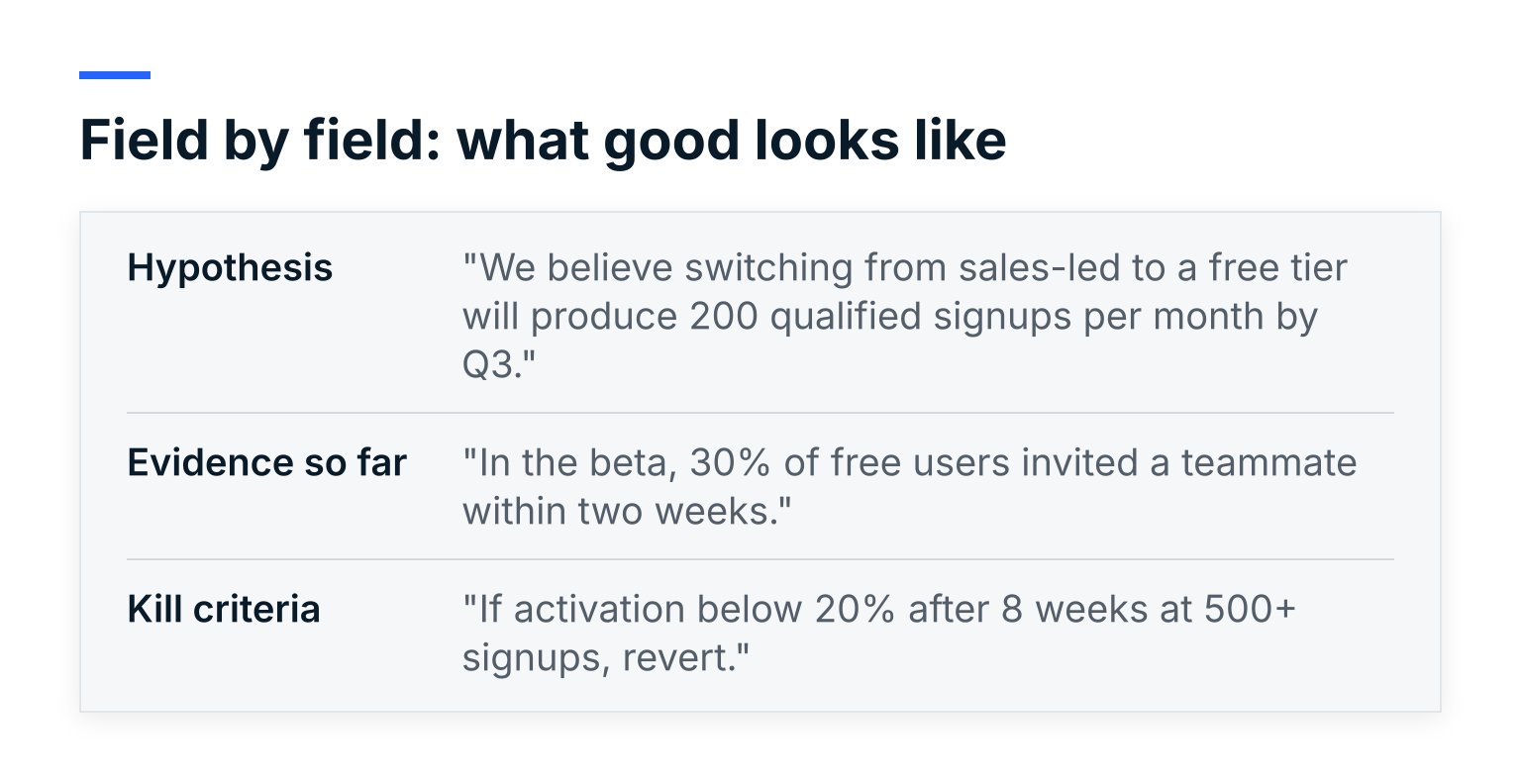
- Hypothesis: "We believe switching from sales-led to a free tier will produce 200 qualified signups per month by Q3."
- Evidence so far: "In the beta, 30% of free users invited a teammate within two weeks."
- Kill criteria: "If activation below 20% after 8 weeks at 500+ signups, revert."
The kill criteria is the part founders skip, and skipping it is expensive. Without a written condition, a failing bet survives on optimism and sunk cost, and the team keeps revisiting the decision every time morale dips. With one, the decision was made before the pressure arrived; when the condition fires, you stop.
If you want a fuller treatment of deciding under changing conditions, our SHARP Loop framework does this in five steps: define the status quo, set the holding range, name observable activators, pre-decide responses, and polish when reality outgrows the loop. Kill criteria in this template are the strategy-level version of the same idea.
We will not: say it before someone makes you say it
Every strategy says what you will do. The useful part is what you will not do, written down where the team and your sales lead can see it.
Good non-goals are specific and slightly painful: "We will not build an on-premise deployment in the next 12 months, even for deals above $50k." If your non-goals would not upset anyone, they are not choices, they are decorations. Tability's guidance makes the same point: each exclusion should be something a reasonable colleague would argue for, and its worked example gives up real revenue segments to prove the point.
A non-goal only works once the people selling know it. Send the non-goals to whoever talks to customers.
Priorities and measures: outcomes with owners, capped by real capacity
Pick at most three priorities. For each, write a measurable outcome, today's baseline, a target with a date, and one named owner. Productboard's strategy template follows the same shape: product objectives paired with measurable outcomes and the tactics underneath them, so the outcome is a result you track, not a task you assign.
The capacity check matters. Add up the people your bets require and compare the total to your actual team. If the bets need 9 engineers and you have 5, the template just did its job: you learned the plan is fiction before you spent a quarter finding out.
From strategy to roadmap
Product strategy and roadmapping are two different jobs, and confusing them is the most common reason roadmaps slip and teams lose faith. The strategy changes rarely. The roadmap changes often. When the two blur, the roadmap becomes a promise list, then a negotiation, then a lie. Amplitude's product strategy guide draws this line plainly: the strategy is the reference point, while the roadmap is the timeline of action items that shifts as deadlines, feedback, and obstacles arrive. We go deeper on the failure mode in Why does my roadmap keep slipping?
The translation rule: every roadmap item should trace to a bet, and every bet should trace to the diagnosis. If an item traces to neither, it is a request, not a plan, and it waits.
Set a review cadence when you write the strategy: monthly for the measures, quarterly for the bets. And write down what would change your mind, as observable conditions, so a competitor launch or a churn spike does not automatically reopen the whole debate. Until a condition you named actually fires, you execute.
Common founder mistakes
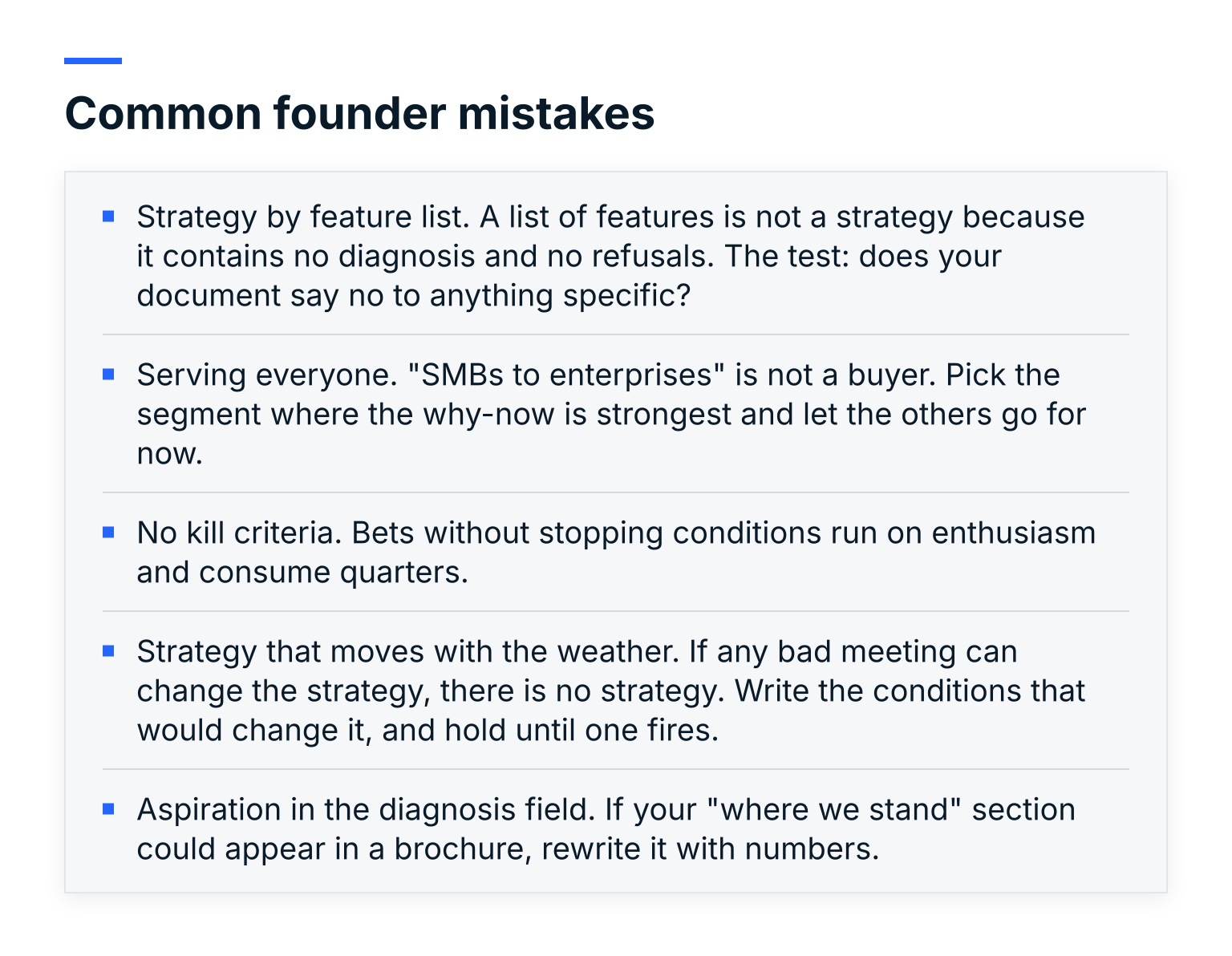
- Strategy by feature list. A list of features is not a strategy because it contains no diagnosis and no refusals. The test: does your document say no to anything specific?
- Serving everyone. "SMBs to enterprises" is not a buyer. Pick the segment where the why-now is strongest and let the others go for now.
- No kill criteria. Bets without stopping conditions run on enthusiasm and consume quarters.
- Strategy that moves with the weather. If any bad meeting can change the strategy, there is no strategy. Write the conditions that would change it, and hold until one fires.
- Aspiration in the diagnosis field. If your "where we stand" section could appear in a brochure, rewrite it with numbers.
A worked mini example (illustrative)
This is a fictional example, not a client case. It shows the quality bar for each field.
Diagnosis: 90 paying customers, $14k MRR, 7% monthly churn. 55% of churned customers cited "setup took too long." Two of four engineers maintain a legacy integration that 12 customers use.
Vision: Mid-sized logistics teams run their dispatch planning inside our tool every morning, without an implementation project.
Buyer and job: Buyer is the operations manager at a 50-200 vehicle logistics company. User is the dispatcher. Job: build next week's dispatch plan in under an hour. Today they use spreadsheets. Why now: fuel cost pressure is forcing them to cut planning overhead this year.
Bets:
- 1.Self-serve onboarding. Hypothesis: cutting setup from 3 weeks to 3 days halves early churn. Evidence: pilot with 5 customers reached first plan in 4 days. Kill criteria: if 30-day retention does not improve at least 2 points across 20 onboarded accounts, revert to white-glove setup.
- 2.Dispatch template library. Hypothesis: starting from a template cuts time-to-first-plan below 30 minutes and lifts trial conversion. Evidence: interviews with 11 dispatchers. Kill criteria: if fewer than 40% of new trials use a template by Q3, drop the library.
We will not: Enterprise fleet-telemetry integrations; custom SLAs; building for carriers under 20 vehicles.
Priorities: Reduce 30-day churn from 7% to 4% by Q4 (owner: founder); raise trial-to-paid from 11% to 18% (owner: growth lead).
Roadmap translation: Q1: onboarding flow rebuild plus 10 templates. Q2: measure against kill criteria; iterate or revert.
Notice how short that is. It fits on one page, and every number could be checked against reality.
FAQ
How often should we update the product strategy?
Review the measures monthly and the bets quarterly. Change the strategy only when a condition you named in advance fires, not whenever the mood shifts.
Is a one-page template enough, or do we need a long document?
One page is enough, and often better. A long document hides weak thinking behind length. If a specific decision (pricing, platform, a fundraise) needs depth, write a separate one-pager for that decision.
Who owns the product strategy?
One person owns it, usually the founder or product lead. Product strategy management is a named accountability, not a committee output: anyone can propose changes, but one person keeps the document current and calls the kill criteria when one fires.
What do investors look for in a product strategy?
They look for a diagnosis that matches the numbers they can verify, a narrow buyer, evidence-backed bets, and evidence that you say no to things. A strategy that promises everything reads as no strategy.
Next step
If you fill this in and want a candid second opinion before you take it to a raise, request a call. We pressure-test product strategy, buyer clarity, and pitch stories with founders preparing to raise, and we can tell you which field in this template is doing the least work. If you want to see how that support works day to day, start with our work with startups, or browse the free tools we publish.