SOC2 for startups: the execution guide
Most startups spend 18 months on SOC2 and still fail the audit. Here's why — and a clear execution path to certify in 90 days without hiring a compliance team.
Most founders approach SOC2 like a security project. It's not. It's an organizational alignment project with a security component. That misclassification is why the average startup spends 12 to 18 months on it and walks out exhausted, over budget, and not entirely sure the audit would hold up to scrutiny.
What SOC2 is
SOC2 (System and Organization Controls 2) is a security certification framework from the American Institute of Certified Public Accountants (AICPA). It evaluates how your company handles customer data across five Trust Service Criteria: Security, Availability, Processing Integrity, Confidentiality, and Privacy.
For most startups, Security is the only required criteria. The rest are optional, depending on your business.
Type I vs. Type II
This distinction matters more than most founders expect.
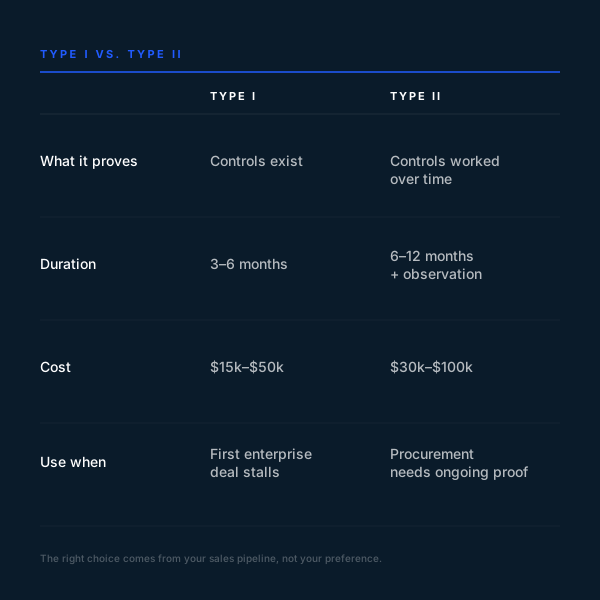
The choice between Type I and Type II should come from your sales pipeline, not your preference. If enterprise deals are stalling on 'do you have SOC2?', start with Type I to unblock revenue, then begin the Type II observation window immediately.
When do you need SOC2?
Later than you think, and often earlier than you start.
You need SOC2 when enterprise prospects start failing you on security questionnaires. That usually happens at Series A or B when your target customer shifts upmarket. Waiting until a deal is blocked is the wrong trigger. At that point you are 6 to 18 months away from having anything to show.
A better trigger: when your first enterprise conversation ends with 'send over your security documentation,' start the SOC2 clock that week. Not the second time. The first.
You probably don't need SOC2 if you're pre-product-market-fit, selling exclusively to SMBs, or operating in a vertical where ISO 27001, a HIPAA BAA, or FedRAMP are what your buyers want.
SOC2 or ISO 27001
The question isn't which framework is stronger. It's which one your buyer names.
| SOC2 | ISO 27001 | |
|---|---|---|
| Origin | United States, AICPA | International, ISO and IEC |
| Usually asked for in | North American enterprise procurement | Europe, the Gulf, much of Asia |
| What it attests | That your controls were designed properly (Type I), or that they ran across a period (Type II) | That you operate a management system for security |
| Path | Type I, then a Type II window. Going straight to Type II is also normal | Stage 1 audit, then Stage 2 |
| Renewal | A fresh Type II observation window, usually annual | Three year cycle with surveillance audits |
The overlap is large. Both want documented controls, access management, vendor review, incident response, and evidence that a control actually ran. Certify to one and you'll reuse most of that work for the other, so the order matters more than the choice.
What decides the timing sits outside your company. A certification is worth buying when something external starts requiring it: a customer contract that names it, a procurement gate, a regulator. Maturity isn't the trigger.
That distinction has a price. A fintech founder came to us holding a $40,000 ISO 27001 quote, recommended by his legal team and confirmed by his security vendor. The certification was roughly 18 months away from being relevant to his business. What he actually had exposed came down to configuration and one piece of paperwork, and it closed for $15,000. The certification programme would have reached those items eventually, on a schedule set by the audit rather than by the exposure.
So, a practical test. Look at your last three stalled enterprise deals and check which framework the questionnaire named. If it was SOC2, start there. If it was ISO 27001, your buyers are telling you something about where your revenue is coming from. If neither came up, you're early, and the money goes further on the gaps a buyer will find than on the certificate that proves you looked.
Why startups take 18 months (and still fail)
There are three real reasons. None of them are 'we didn't have the right security tools.'
1. No single owner
SOC2 touches engineering (infrastructure controls), product (data handling), HR (access management, background checks), legal (vendor agreements), and the CEO (risk acceptance decisions). When no one person owns the outcome, every dependency becomes a negotiation. Work moves in bursts. Momentum dies between sprints.
Most startups assign SOC2 to either their Head of Engineering (who treats it as an infrastructure ticket) or Head of Operations (who treats it as a documentation project). Both framings miss the point.
SOC2 needs an owner who can drive decisions across functions without getting stuck in the hierarchy. That person either exists in your company or doesn't. If they don't, you need to hire them or bring in someone who has done this before.
2. Scope drift
Before you spend a dollar on tooling or a compliance platform, your leadership team needs to agree on what is and isn't in scope. Which systems? Which data? Where does your control environment begin and end?
This sounds obvious. It isn't. Scope disagreements between engineering and product (which features count), between security and leadership (which risks are acceptable), and between your startup and your auditor (what evidence you need) cause more delays than any technical gap.
Every time you expand or contract scope after work has started, you reset a portion of your evidence-gathering cycle. Teams that lock scope on day one finish their audits in roughly half the time.
3. Sequential remediation
The default approach: hire a compliance consultant, complete a gap assessment, receive a long list of items, work through them one by one, call the auditor. The problem is that list is long, and most items on it are not blocking. Most startups treat remediation as a queue when it should run in parallel.
Triage the gap assessment into three buckets: items that block the audit from starting, items that need to be in place before the observation window closes, and items that are nice to have. Most teams over-invest in the third bucket before they've cleared the first.
The 90-day path to SOC2 Type I
This assumes your cloud infrastructure is reasonably modern, you have fewer than 100 employees, and you have a dedicated owner. It is not a guarantee. It is the fastest credible path for a startup with no prior compliance work.
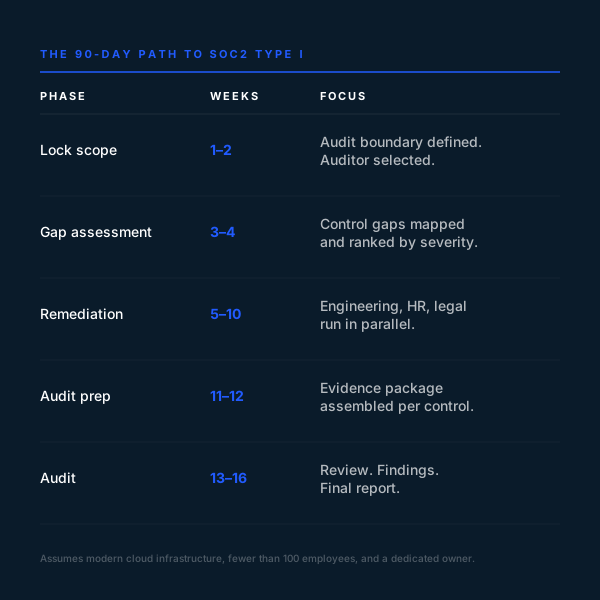
Three decisions that separate fast from slow
Pick your compliance approach before remediation starts. Your options: build your own documentation and evidence workflows, use a compliance platform, or hire a compliance manager. Each makes sense at different stages. The mistake is deferring the decision. Teams that adopt a platform mid-remediation end up doing significant work twice.
Run your vendor review early. Every third party that processes in-scope data needs a security review and a Data Processing Agreement. This work is tedious, takes longer than anyone expects, and regularly surfaces vendors that can't meet your requirements. Start in week three, not week ten.
Talk to your auditor before the formal audit starts. Startups that arrive at audit day with surprises are startups that went quiet during readiness. Send your gap assessment when it's done. Flag controls you're uncertain about. A good auditor will give you guidance before the clock starts. Use it.
What SOC2 costs
Three cost categories founders routinely underestimate.
Auditor fees for Type I run $15,000 to $50,000. Readiness consultant fees, if you use one, add $10,000 to $30,000. Compliance platform licensing runs $15,000 to $30,000 per year.
Then there are the indirect costs. For a 15-person startup, plan for 1.5 to 2 full-time-equivalent months of combined engineering, operations, and leadership time across the full process. That time has a cost.
SOC2 is also not a one-time event. After certification, you're maintaining controls, training new hires, reviewing vendor agreements annually, and preparing for your Type II window or annual recertification. Budget roughly 0.25 FTE ongoing for a startup under 50 people.
Total realistic cost to go from zero to Type I for a Series A startup: $60,000 to $120,000 all-in, including indirect time.
The fastest way to stall
The companies that finish SOC2 fastest are not the ones with the most mature security posture. They are the ones with the clearest internal alignment on scope, ownership, and priorities.
Security tools close technical gaps. Organizational clarity closes execution gaps. Most SOC2 projects stall in the second category.
If your SOC2 project has been running for more than six months with no audit date on the calendar, the problem is almost certainly organizational, not technical. You probably have an unclear owner, a scope that keeps shifting, or blockers that nobody has the authority to resolve.
Where SHA/RP fits
SOC2 is one of the more common situations we work on, not because it's a security problem, but because it surfaces every organizational misalignment that was already there: ownership gaps, scope disputes, teams moving without converging.
The Kickstart is a 5 to 10 day intervention for exactly this situation. We identify what's blocking convergence, force alignment on scope and ownership, and hand over an execution plan that all stakeholders have bought into.
Related: The Kickstart
5 to 10 days. Identify what's blocking convergence, align on scope and ownership, hand over an execution plan.
The KickstartAlso relevant: The Security Diagnosis
Fixed scope. What you have, what you need, what is overkill.
The Security DiagnosisRead next
- Startups Scale Too Early. The Basics Are Still Broken
An hour on The CTO Show with Mehmet, on why security, sales, and product all fail the same way: a step taken before the step it depends on.
- AI Sovereignty in the Gulf: The Procurement Question That Actually Matters
Infrastructure bets are placed. What changes is how procurement reads you.
- A Busy Company and a Converging Company Look Identical
Same full calendars, same tickets closing, same energy in the standup. One is compounding. The other is dispersing.