Launching a New Product: A Go-to-Market Checklist for Startup Founders
A founder-run launch strategy for a new product: ten decisions in order, from success criteria and buyer definition to one channel, three phases and pre-agreed gates.
Summary of the article
A launching strategy for a new product is a sequence of decisions, not a list of tasks. Decide what success means in numbers, pick one buyer and one channel, write your positioning, then move through pre-launch, launch and sustain with agreed gates between each phase. Most first launches fail before launch day: the goal was vague, effort was spread across five weak channels, and nobody planned for the week after the announcement.
- Decide the goal first: write down what "the launch worked" means, in numbers, before anything else.
- Pick one segment and one buyer: the clearest-need group, not the biggest market.
- Commit to one primary channel: add a second only after the first one works.
- Sequence in three phases with gates: pre-launch, launch window, sustain. Moving between them is a decision, not a date.
- Run the launch narrow: soft-launch to a pilot group, watch activation daily, fix what breaks before you scale.
What a launch strategy actually decides
A go-to-market strategy for a new product answers five questions: who is it for, what problem does it solve, what do they use today, why is yours different, and how will they find out? A launch plan then turns those answers into a timed sequence. The order matters. If you pick channels before you know who buys, you will market to people who like the product but never pay for it.
What follows is a checklist you can run before your next launch. Each item is a decision with a concrete output: a sentence, a number, a name, or a table. If an item has no output, it is not finished.
The checklist at a glance
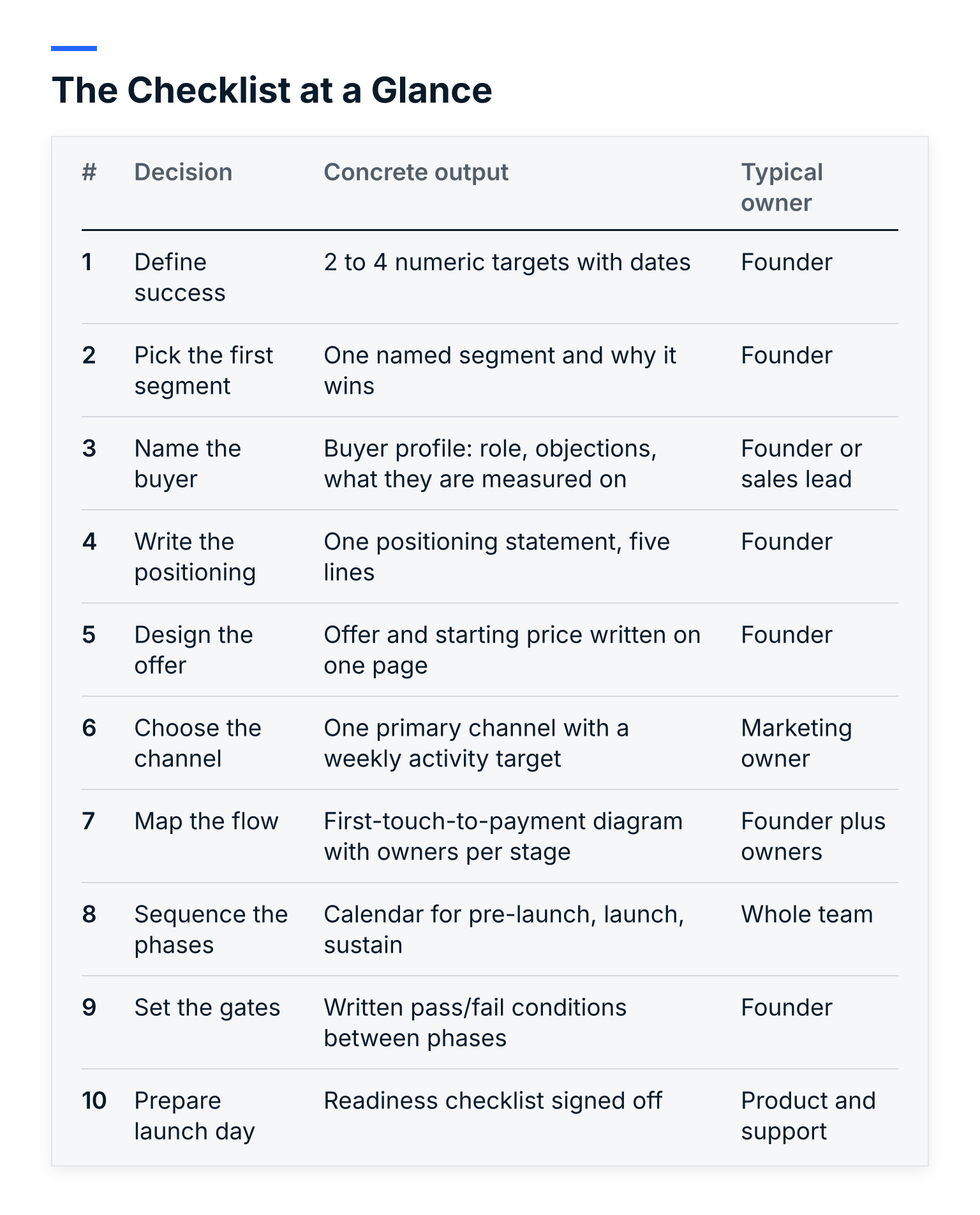
| # | Decision | Concrete output | Typical owner |
|---|---|---|---|
| 1 | Define success | 2 to 4 numeric targets with dates | Founder |
| 2 | Pick the first segment | One named segment and why it wins | Founder |
| 3 | Name the buyer | Buyer profile: role, objections, what they are measured on | Founder or sales lead |
| 4 | Write the positioning | One positioning statement, five lines | Founder |
| 5 | Design the offer | Offer and starting price written on one page | Founder |
| 6 | Choose the channel | One primary channel with a weekly activity target | Marketing owner |
| 7 | Map the flow | First-touch-to-payment diagram with owners per stage | Founder plus owners |
| 8 | Sequence the phases | Calendar for pre-launch, launch, sustain | Whole team |
| 9 | Set the gates | Written pass/fail conditions between phases | Founder |
| 10 | Prepare launch day | Readiness checklist signed off | Product and support |
The launch checklist: ten decisions in order
1. Define what "the launch worked" means
Before any plan, write two to four numeric targets with dates. For example: 30 paying customers in 60 days, 40% of new signups completing the core action in week one, and 20 buyer conversations booked. Vague goals like "buzz" or "awareness" cannot fail, which means they also cannot teach you anything.
Pick targets you can actually measure. If your product is software, define the activation event (the action that shows a user found value) before launch, not after. Amplitude's product benchmarks, built from over 2,500 companies, show how widely activation and retention vary, and they are a useful sanity check when you set your own numbers. If you cannot measure a target with the tools you have, either instrument it now or pick a different target.
2. Pick your first segment
Choose the group with the clearest need and the shortest decision, not the largest market. A segment you can win beats a market you can only be visible in. Geoffrey Moore's Crossing the Chasm makes the classic case: focus on one tightly defined segment and nail one use case there before widening.
A usable segment description names an industry, a company size, a role and a situation. "Clinics with two to five therapists that lose bookings to no-shows" beats "healthcare". You can expand later; you cannot go back and build trust with a first group you skipped.
3. Name the buyer, not just the user
For most products, the person who uses it is not the person who signs the invoice. The buyer has a job title, a budget, objections, and things they are measured on. Write these down: what they own, what scares them about switching, and what a good quarter looks like for them.
This is the single most common gap we see in founder GTM plans, and it is expensive. If you build and market for the user while the buyer holds the budget, you will get praise and no revenue. We have written about why the buyer isn't the user and what that mismatch costs you. Check your segment against this: if you cannot name the buyer, the segment is not ready.
4. Write the positioning
Write one statement in five lines: for who, with what problem, who currently use what, we are different because what, so they get what outcome. HubSpot documents a common version of this template, and it works well for founder-scale products.
The hard part is honesty about the "what they use today" line. Usually the real alternative is a spreadsheet, a generalist tool, a contractor, or nothing at all, not the competitor you like beating. Position against the alternative your buyer actually reaches for. Test the statement on five people outside your team and ask them to repeat back who it is for. If their answers drift, cut adjectives until the statement survives. Our guide to product positioning strategy walks through the full process.
5. Design the launch offer and simple pricing
Decide what someone gets when they say yes in week one, and what it costs. Keep pricing simple: one or two options, clearly named. The offer is not always a discount. A longer trial, onboarding included, a done-with-you setup, or a pilot with named success criteria are often stronger than cutting the price, and they protect your perceived value.
Write the offer on one page. If it takes more than one page to explain, it is too complicated to sell in a launch window.
6. Choose one primary channel
Pick the one channel your segment already uses when they buy things like yours: a specific community, a marketplace, outbound to a named role, partners, or search. Set a weekly activity target for it (for example, 25 outbound conversations or two community posts per week) so you can tell effort from results.
The tradeoff is real: one channel feels slow, and it is. But five half-efforted channels give you five data sets too small to learn from. Add a second channel only when the first has produced enough signal to judge, which usually means weeks of consistent activity, not days.
7. Map the minimal acquisition flow
Draw the path from first touch to paying customer: where they hear about you, what they do next, who talks to them, what makes them pay. Put an owner's name on every stage. A stage with no owner is where leads go to die.
Keep it minimal. Early launches typically have three to five stages. If your diagram needs ten boxes, you are designing a process for a company three times your size.
8. Sequence the launch in three phases
- Pre-launch: build a list of real prospects (not just newsletter signups), instrument tracking, prepare sales and support materials, run a small beta.
- Launch window: make the announcement, run conversion activity, watch activation daily, talk to every user you can.
- Sustain: keep the primary channel running every week, publish what you learned, choose the next segment.
A launch is a quarter with a spike in the middle, not a day. If you treat it as a day, you will have nothing running the week after, when the people who saw the announcement decide whether to come back. This sequencing logic is the same one behind our argument that aiming directly at the goal is the slowest path to it: optimise for the stage you are actually on.
9. Set phase gates before launch day
Agree now, in writing, what must be true to move from pre-launch to launch, and from launch to sustain. Examples: "we launch when 15 pilot users have completed the core action" and "we move to sustain when week-one activation hits 40%". Gates turn phase changes into decisions with evidence instead of calendar dates nobody wants to argue with.
Gates also protect you from both failure modes: launching too early to save a date, and polishing forever because nobody defined "done". Being first to market is worth less than founders often assume; research going back decades, summarised by Kerin, Varadarajan and Peterson, shows first-mover advantage is conditional, not automatic. A gate lets you be late and right.
10. Prepare launch-day readiness, then run it narrow
Before the window opens, tick these off:
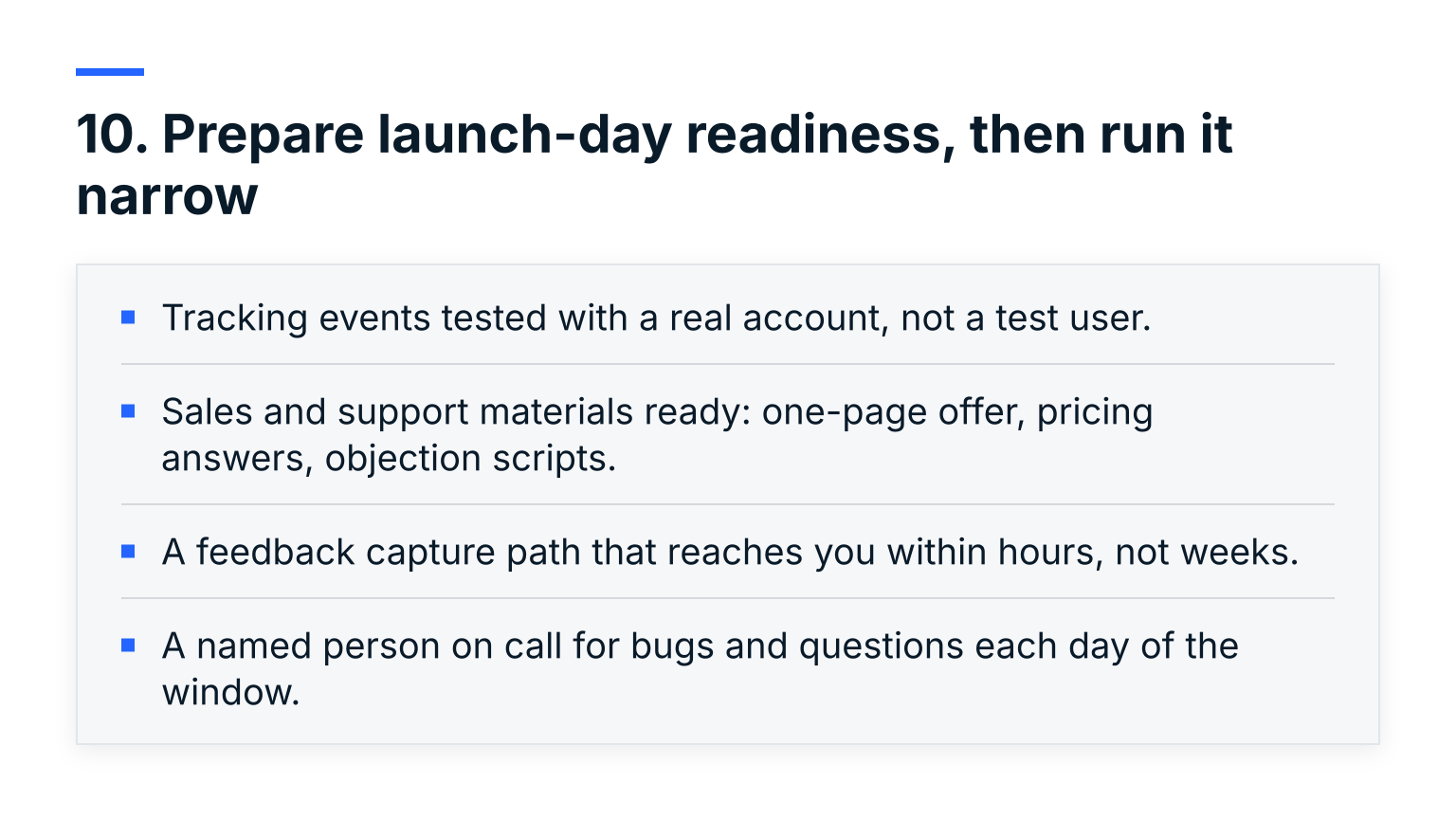
- Tracking events tested with a real account, not a test user.
- Sales and support materials ready: one-page offer, pricing answers, objection scripts.
- A feedback capture path that reaches you within hours, not weeks.
- A named person on call for bugs and questions each day of the window.
Then run the launch narrow. Soft-launch to a pilot slice of your segment, watch activation daily against your targets, and fix what breaks while the blast radius is small. Scaling a broken funnel multiplies the breakage. Widen only when the pilot numbers hold.
The failure modes that sink first launches
Four patterns account for most first-launch failures, and every one of them is preventable at the checklist stage:
- Vague goals. "Generate buzz" cannot fail, so it cannot inform anything. Fix: targets from item 1.
- Five weak channels. Effort spread thin produces no learning. Fix: one primary channel from item 6.
- No sustain plan. The announcement fires, then everything goes quiet. Fix: the sustain phase from item 8.
- Measuring after the fact. Deciding what success meant after you see the numbers guarantees a story, not a lesson. Fix: gates and targets written before launch, per items 1 and 9.
If you recognise your current plan in any of these, that is the item to work on first.
Launch strategy questions, answered
How long should the launch window be? Long enough to reach your segment more than once through your primary channel, usually one to two weeks of active push. The exact length matters less than having agreed in advance what you will watch daily.
Do we need press coverage for the launch to work? Only if your segment actually buys through press. Check item 6 first: if your buyers come from a community or outbound, press is a nice extra, not a success condition.
What if we can't define activation yet? Then set a provisional definition now and commit to revising it once, after the pilot, based on what your best early users did in their first session. Do not launch with no definition; that is how "measuring after the fact" happens.
When should we add a second segment or channel? When the first gate to sustain has passed and the primary channel produces consistent results week over week. Expanding before that doubles your variables and halves your learning.
Where to go from here
This checklist is runnable by a founder with a small team and one focused quarter. The output you should walk away with: numeric targets, one segment, one buyer profile, one positioning statement, one channel, a three-phase calendar with gates, and a readiness checklist.
If you would rather execute it with experienced GTM leadership beside you, that is what SHA/RP's fractional CPO and go-to-market work is for: clarifying who buys, why they buy now, and how sales should position the product. Broader startup support, including fundraising prep, lives on our startup services page, and our free tools are a low-commitment way to pressure-test your thinking first.
If you want to talk through whether advisory support fits your stage, request a call and we will discuss it candidly.