Product Differentiation Explained: How Startups Stand Out and Prove It
What product differentiation really means, the three types, where a differentiator can live, and how to prove it with data before you take it to investors.
Summary of the article
Product differentiation means your product has a difference that buyers can perceive, value, and act on: they pay more for it, or they refuse to switch away from it. Most of what founders pitch as differentiation is a feature competitors can ship in a quarter, which is a head start, not a moat. The classic frameworks (vertical, horizontal, and mixed differentiation) help you place your product, and a short set of proof signals tells you whether the difference is real.
- Vertical differentiation: buyers agree yours is better, and some will pay more for it.
- Horizontal differentiation: buyers prefer your flavor of the product, not because it is better.
- Mixed: most real products are both, and you need to know which part carries your pitch.
- The test that matters: would a meaningful segment pay more, or refuse to switch for a cheaper alternative?
What product differentiation is (and what it is not)
Product differentiation is any difference between your product and the alternatives that a buyer notices, cares about, and pays for. Two conditions are doing the work in that sentence. The buyer must perceive the difference, and the difference must change a buying decision. A difference that is invisible to the buyer is engineering, not positioning. A difference the buyer notices but will not pay for is trivia.
In economics, product differentiation is the reason two products that do roughly the same job are not perfect substitutes. If buyers see them as interchangeable, they buy the cheaper one, and price competition eats your margin. If they see a real difference, you have room to charge more or keep a loyal segment. The payoff, as the Startups.com lexicon entry puts it, is competing on something other than price.
Two things people call differentiation are not:
- More features. A feature list is usually a description of parity. If every competitor has, or will soon have, the same capabilities, the list is table stakes, and table stakes do not win deals.
- Being better at the same things. Michael Porter's argument in What Is Strategy? is that operational effectiveness (doing similar activities better than rivals) is necessary but not a strategy. Best practices diffuse. Faster, cleaner, cheaper-executed versions of the same product converge on the same position, and the race ends in a price war.
Real differentiation is a deliberate difference in what you offer, not just how well you execute. It is also a choice: you get it by deciding what you will not do, because trade-offs are what make a position hard to copy.
The three types of differentiation
Economists sort differentiation into types by how buyers judge the products. Most modern guides, including Shopify's explainer, break it into the same three.
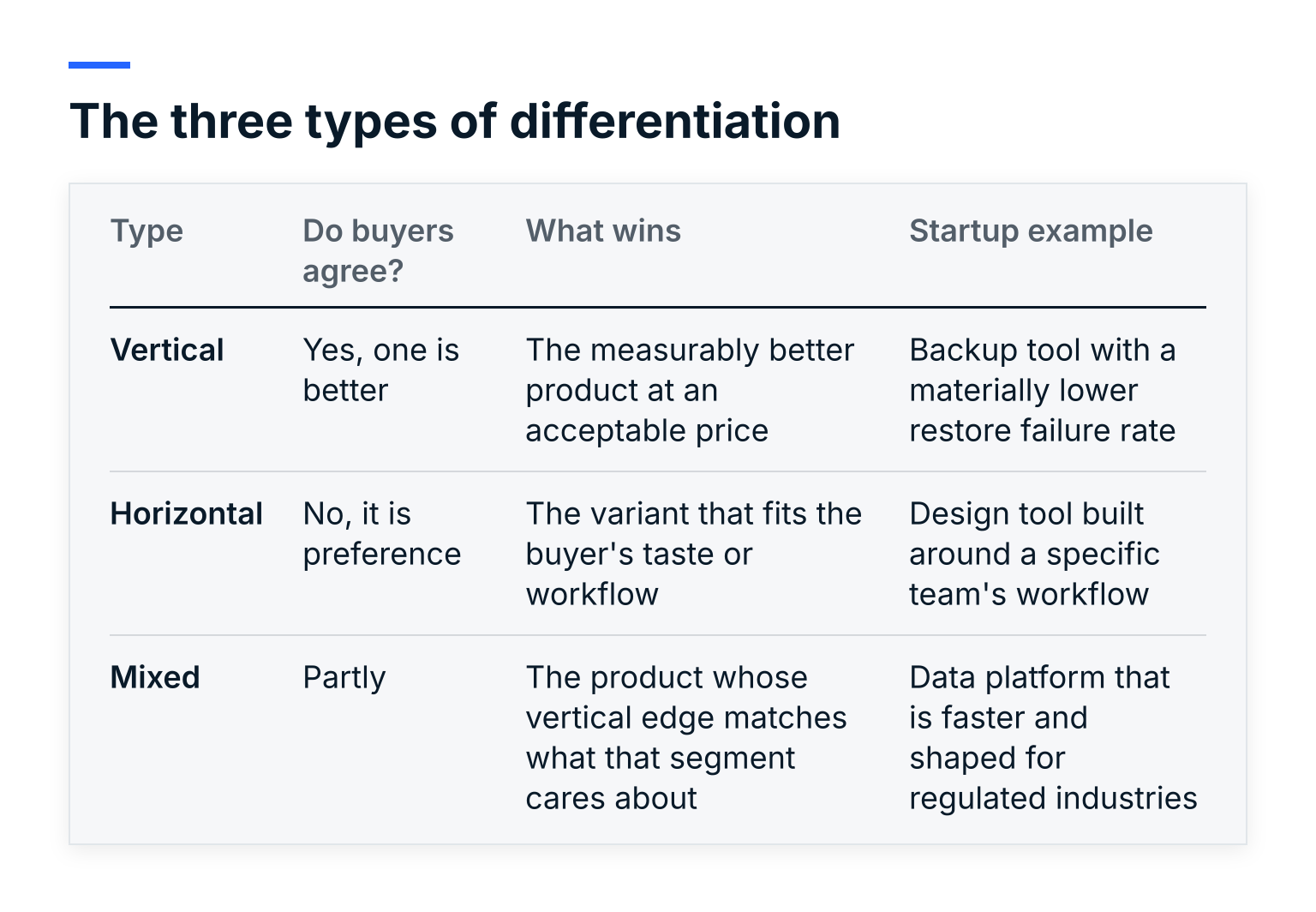
Vertical differentiation is a quality ranking that almost everyone agrees on. At the same price, buyers pick the better product. Think of a database that is measurably faster at the workload your buyers run, or a security tool with fewer false positives. Vertical differences invite a simple question: how much better, and does that gap matter enough to pay for? It also erodes fastest, because the leader's gap is a public target.
Horizontal differentiation is a preference ranking that people disagree about. One dashboard layout, one integration ecosystem, one flavor of workflow is not objectively better; it just fits some buyers. Chocolate ice cream is not better than lemon. Horizontal differentiation is where niches live, and it is often the most defensible space for a startup, because a big competitor will not reshape its product to serve your segment.
Mixed differentiation is most products. A laptop is better on some dimensions (battery life) and a matter of taste on others (design language). The practical question for a founder is: which part of my difference is vertical, which is horizontal, and which one actually drives the buying decision?
| Type | Do buyers agree? | What wins | Startup example |
|---|---|---|---|
| Vertical | Yes, one is better | The measurably better product at an acceptable price | Backup tool with a materially lower restore failure rate |
| Horizontal | No, it is preference | The variant that fits the buyer's taste or workflow | Design tool built around a specific team's workflow |
| Mixed | Partly | The product whose vertical edge matches what that segment cares about | Data platform that is faster and shaped for regulated industries |
Where differentiation can live, and how hard it is to copy
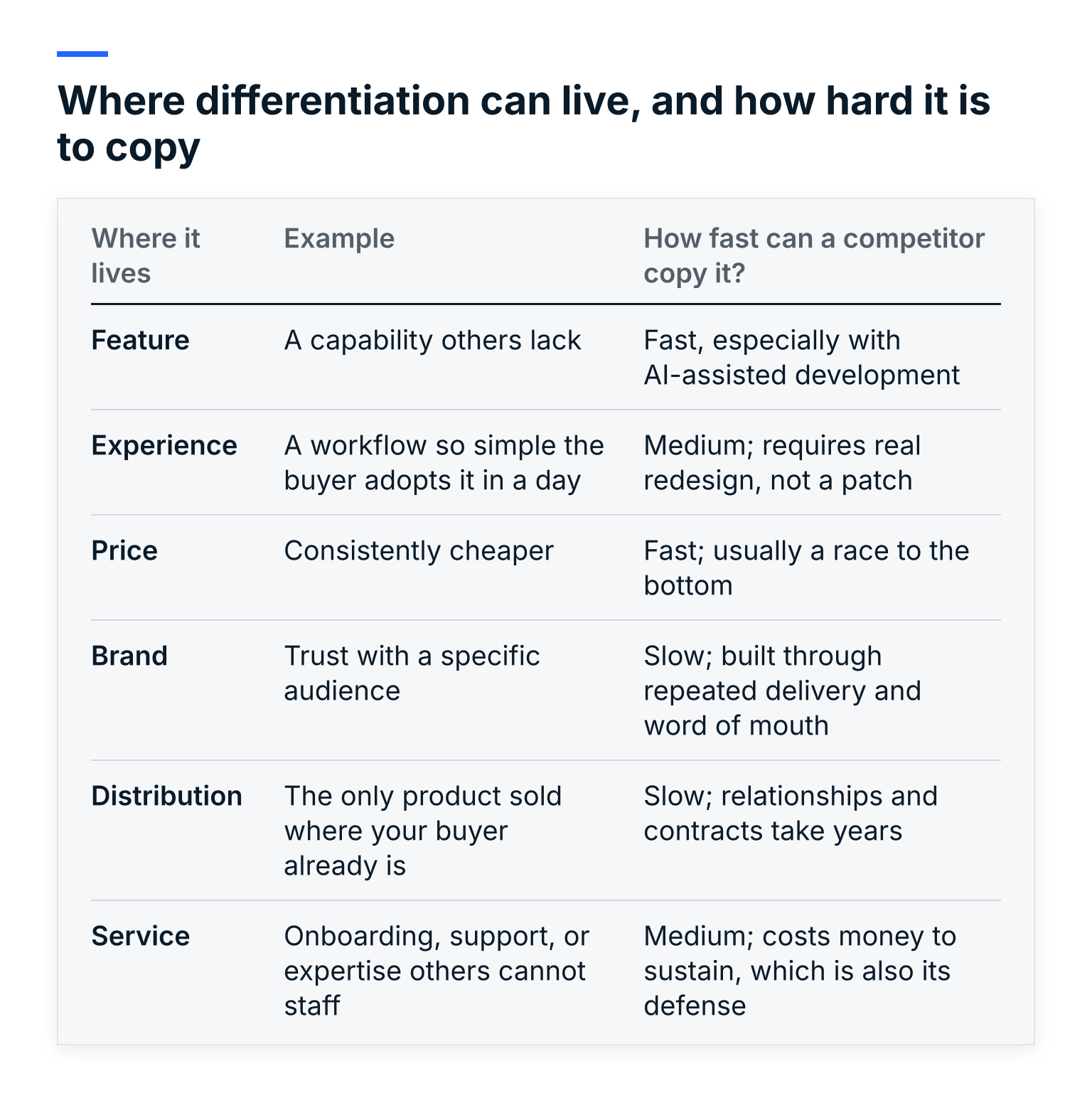
A differentiator does not have to be a feature. It can live in several places, and the best ones are usually not the places founders look first. Atlassian's product management guide names features, quality, price, service, and brand identity as the mix that can carry differentiation, and some of these influence buying decisions far more than others.
| Where it lives | Example | How fast can a competitor copy it? |
|---|---|---|
| Feature | A capability others lack | Fast, especially with AI-assisted development |
| Experience | A workflow so simple the buyer adopts it in a day | Medium; requires real redesign, not a patch |
| Price | Consistently cheaper | Fast; usually a race to the bottom |
| Brand | Trust with a specific audience | Slow; built through repeated delivery and word of mouth |
| Distribution | The only product sold where your buyer already is | Slow; relationships and contracts take years |
| Service | Onboarding, support, or expertise others cannot staff | Medium; costs money to sustain, which is also its defense |
Notice the pattern: the easiest things to copy (features, price) are the ones founders most often lead with. The harder-to-copy places (brand in a niche, distribution, service depth) take longer to build, which is exactly why they hold. A quick way to stress-test any claim is to ask: if a well-funded competitor wanted this tomorrow, what would stop them? If the answer is nothing, you have a head start, not a moat.
"AI-powered" is not a differentiator
Right now, "AI-powered" appears in nearly every product pitch. That is the definition of table stakes: something your market assumes you have, and which stops being a reason to choose you the moment everyone has it. The same was true of "cloud-based" a decade ago and "mobile-first" shortly after.
This matters more because AI has also made building features cheaper, which shortens every head start. If your differentiation is a feature, assume a competitor ships it within two quarters. If it is a workflow, a data asset, a distribution channel, or trust with a specific buyer, the copy job is slower and more expensive. For more on how this changes product decisions, see If AI makes features cheap to build, how do we decide what to build?
The test: would they pay more, or refuse to switch?
Strip away the language and differentiation comes down to one question: would a meaningful segment of buyers pay more for your product, or refuse to switch to a cheaper alternative?
If the answer is no, you have parity with better marketing. If the answer is yes for a segment, you have something, even if the segment is small. Niche products with a segment that will not leave them are worth more than broad products everyone is willing to swap out.
Two honest caveats:
- The segment must be meaningful. "Some customers love us" is true of almost every product, including failing ones.
- Willingness to pay is behavior, not survey answers. People tell surveyors they value things they will not pay for.
How to verify a claimed differentiator with data
Before you take a differentiator to investors or bake it into your positioning, look for three kinds of evidence:
- 1.Used without being pushed. The claimed strength is among the most-used parts of your product, not a feature users stumble into once.
- 2.They came back. Repeat use over weeks and months, and retention that holds or improves for the segment that buys because of the differentiator.
- 3.They said it first. Unprompted mention. When a customer describes you to a colleague in their own words, does the differentiator show up? If you only hear it when you ask leading questions, buyers have not internalized it.
A simple review works like this: pick your claimed differentiator, segment usage by whether the account bought because of that claim, and compare usage, retention, and expansion between that group and everyone else. If the group that bought on the differentiator behaves the same as everyone else, the claim is decoration.
One trap to watch: self-selection. The customers who buy on your differentiator may simply be the ones who were always going to love you. Ask what would happen if the differentiator disappeared. Would they churn, or shrug? Churn intent, even measured crudely, is more informative than satisfaction scores. For the broader evidence investors actually probe, see What is product-market fit? How to tell if you have it (and prove it to investors).
| Proof signal | What it looks like | How to measure it |
|---|---|---|
| Used without prompting | The differentiating capability is a top-used feature for the buyer-driven segment | Usage share of the feature, by acquisition reason |
| They came back | Repeat use and retention hold for the segment | Week-over-week and month-over-month retention by segment |
| They said it first | Customers name the difference in their own words | Review of sales calls, support notes, and referrals for unprompted mentions |
Four mistakes founders make with differentiation
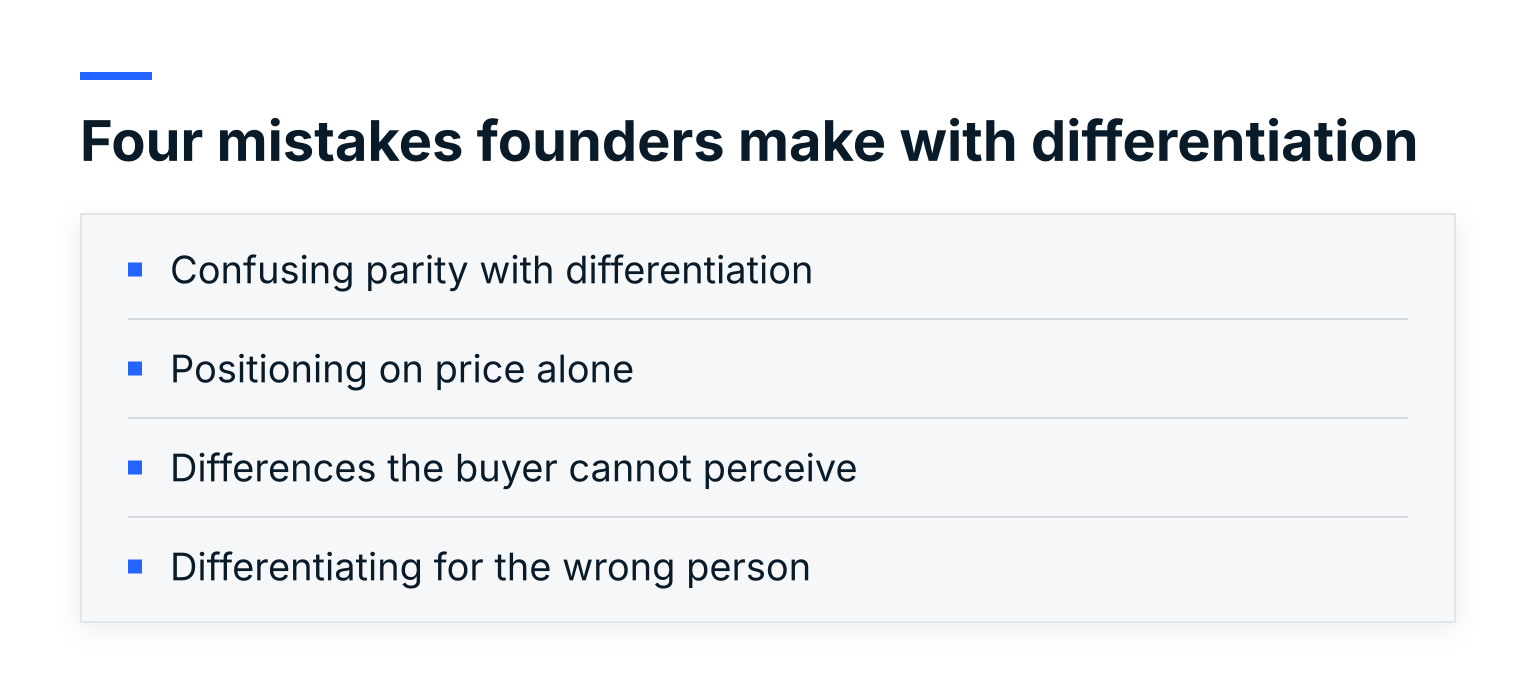
- Confusing parity with differentiation. A feature list where every item is matched by two competitors is a parity list. If a buyer can swap you for an alternative with no switching cost, you have not differentiated; you have described the category.
- Positioning on price alone. Price is easy to copy and easier to undercut. If cheaper is your only claim, you are renting your position until someone with more funding arrives. Price can reflect differentiation; it is rarely the differentiation itself.
- Differences the buyer cannot perceive. Your architecture, your model accuracy, your internal quality bar: none of it counts until it shows up in something the buyer experiences or can verify. If the buyer cannot see it, either make it visible or stop leading with it.
- Differentiating for the wrong person. A difference that delights the end user but does not move the person signing the contract will not close deals. Getting clear on who actually buys is the prerequisite, and it is a common failure mode, as You're Burning Runway Building for the Wrong Person explains.
Turning differentiation into messaging buyers and investors remember
Once you have a differentiator and some proof, the job is compression. Investors hear dozens of pitches; buyers sit through dozens of demos. What survives is one sentence that links the difference to the outcome the buyer wants.
A usable pattern: for [specific buyer], [product] is the only [category] that [differentiator], which is why [proof]. The proof slot is where your evidence lives: a retention figure, a switching behavior, an unprompted-mention story. A vague sentence cannot carry evidence, which is part of why vague pitches blur together.
Two tests for the sentence: could a competitor paste in their name and it still be true? Then it is category description, not differentiation. Does the buyer's problem appear at all? If not, it is about you, not them. The discipline of getting this into one sentence is covered in Pitch It to Me in One Sentence, and the broader framing work in Product Positioning Strategy: What It Is, Examples, and How to Build Yours.
When differentiation is temporary, and why that can still be fine
Be honest about shelf life. Most differentiators decay. A technical gap closes, a workflow advantage gets rebuilt, a niche gets noticed. That is not a reason to avoid trying; it is a reason to know which kind you have.
- A head start buys you a window. The right play is to use the window to accumulate the slower-to-copy assets: customer relationships, distribution, data, brand in a segment. Speed matters most here.
- A structural position (unique distribution, deep integration into a workflow, trust that took years) buys you time. The right play is to protect it and keep widening it.
The mistake is treating a head start as a moat and underpricing the window. The opposite mistake is refusing to move until you have found a permanent advantage, which does not exist in most markets.
Where to go next
Differentiation is one of the core choices inside a product strategy, so the natural next step is What Is Product Strategy? A Startup Founder's Guide. If you are closing in on evidence that buyers value your difference, the product-market fit explainer covers what investors will ask for. And if you are still searching for the difference that will hold, that is positioning work: deciding who buys, why they buy now, and what only you can claim.
Choosing and defending a differentiator is exactly the kind of decision a fractional CPO helps a startup make, and it is the work SHA/RP does with founders, from reworking the pitch through fundraising prep to fractional product leadership. If you want a second pair of eyes on whether your claimed differentiator would survive the test in this article, request a call and we will tell you plainly.
Frequently asked questions
What is product differentiation in marketing?
It is the set of differences between your product and alternatives that buyers perceive and act on, by paying more, choosing you over an equal-priced rival, or refusing to switch. In marketing terms, it is the substance your positioning and messaging must be built on. Messaging without a real difference behind it is a claim, and buyers discount claims quickly.
What is the difference between differentiation and positioning?
Differentiation is the fact: what is actually different about your product and whether buyers value it. Positioning is the decision about how you want buyers to perceive you relative to alternatives, and the messaging that expresses it. Positioning built on differentiation you cannot prove collapses under the first serious sales cycle; positioning built on proven differentiation is easy to defend.
Can a startup differentiate on price?
Only in a limited sense. Being cheaper is copyable and attracts the least loyal buyers. What can work is a different cost structure or a deliberately stripped-down product that a specific segment prefers, which is really horizontal differentiation expressed through a lower price. If your only answer to "why you?" is "cheaper," expect to lose the next round to whoever prices lower.