What Is Product Strategy? A Startup Founder's Guide
A product strategy is a small set of explicit choices about market, needs, differentiators and business goals. Learn what it is, what it is not, and how to write one that fits on a page.
Summary of the article
A product strategy is a short set of explicit choices about who your product is for, what problem it solves, what makes it different, and what it must do for the business. It sits between your vision (the long-term change you want) and your roadmap (what you build next). If your strategy is real, it makes saying no easy. If it is not, every feature request sounds reasonable.
- Strategy answers four questions: who, why, why us, and what is in it for the company.
- A roadmap is not a strategy. It is the plan that carries a strategy out.
- A good startup strategy fits on one page and holds for months, not days.
A plain definition
A product strategy is the approach you have chosen to make your product successful. Not a slogan and not a plan full of dates. It is a consistent set of choices that answers four questions:
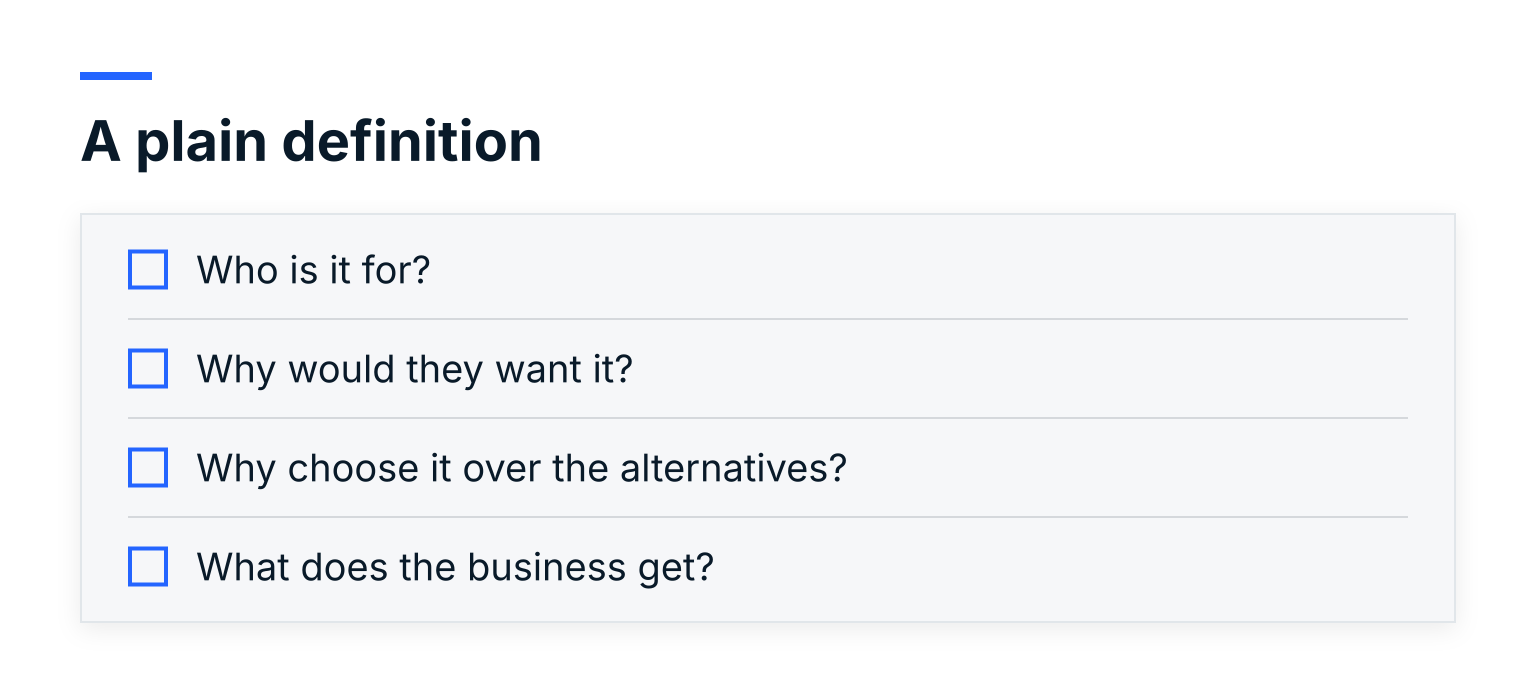
- 1.Who is it for? Which users and which customers, specifically.
- 2.Why would they want it? What problem it solves, in their words.
- 3.Why choose it over the alternatives? What the product is and what makes it stand out.
- 4.What does the business get? Revenue, cost reduction, market position, whatever justifies investing in it.
This structure comes from product strategist Roman Pichler, whose elements of an effective product strategy describe exactly these parts: market, needs, key features and differentiators, and business goals. The model is common because it works. Four questions, four answers, one page.
Notice what is missing from that list: a feature list, a release schedule, and a promise to "delight customers." Those live elsewhere. Strategy is the layer that decides which features deserve to exist in the first place.
What a product strategy is not
Founders often file the wrong artifact under "strategy." Here is the difference:
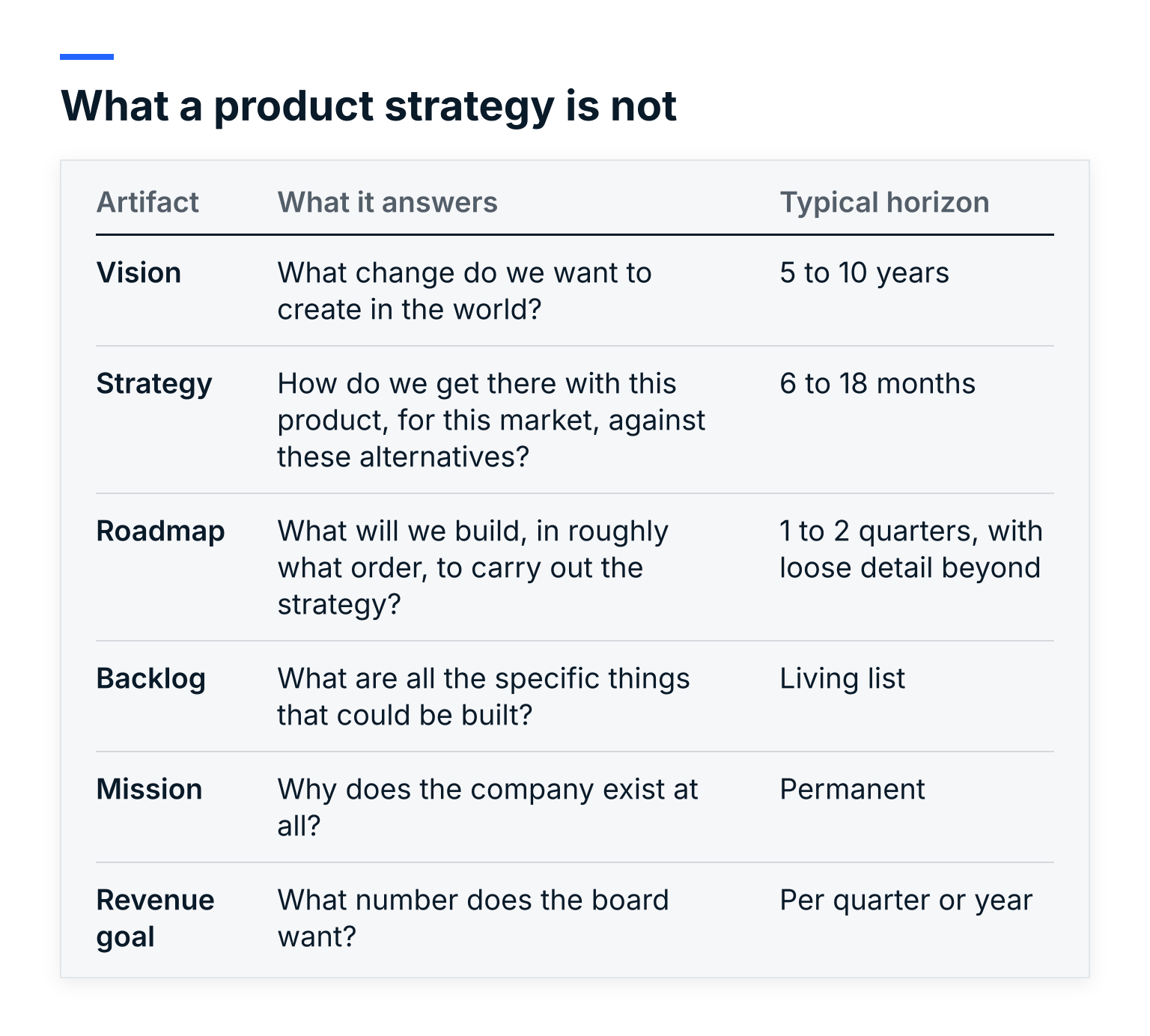
| Artifact | What it answers | Typical horizon |
|---|---|---|
| Vision | What change do we want to create in the world? | 5 to 10 years |
| Strategy | How do we get there with this product, for this market, against these alternatives? | 6 to 18 months |
| Roadmap | What will we build, in roughly what order, to carry out the strategy? | 1 to 2 quarters, with loose detail beyond |
| Backlog | What are all the specific things that could be built? | Living list |
| Mission | Why does the company exist at all? | Permanent |
| Revenue goal | What number does the board want? | Per quarter or year |
Amplitude's product strategy guide draws the line plainly: the strategy is the reference point, and the roadmap is the timeline of work that carries it out. If your "strategy document" is mostly a timeline of features, you have written a roadmap and called it strategy. That is the single most common version of this mistake, and it shows up in a predictable way: the roadmap keeps slipping because it was never connected to a set of choices about market and positioning. We covered that failure pattern in why does my roadmap keep slipping.
A revenue goal is also not a strategy. "$2M ARR by end of next year" says nothing about who you will win that revenue from or why they will pick you. A revenue goal is a target. Strategy is how you intend to hit it.
Strategy is mostly about saying no
The test of a real strategy is not what it includes. It is what it rules out.
If you have chosen to win solo founders with a self-serve product, then enterprise sales-led deals are off the menu. If you have chosen to win on speed and simplicity, then you are declining to compete on breadth of features. Those refusals are the strategy. Everything else is aspiration.
This is why a company without a strategy feels busy but never converges. Every opportunity sounds plausible because nothing has been ruled out. We wrote about the difference between those two states in a busy company and a converging company look identical: they look the same from the outside, but one of them is making progress and the other is just moving. The underlying skill is telling signal from noise, which is what what matters and what's filler is about: most of what lands on your plate is filler, and a strategy is the filter that sorts it.
The discipline has a cost, though, and honest strategy-writing means admitting it. Choosing a niche means losing deals outside it. Saying no to big logos feels reckless when runway is short. A strategy you only enforce when it is convenient is not a strategy.
The four components, grounded in startup reality
Target market. Who buys, and who uses, because these are often different people. If you sell to a company, a buyer signs and a user logs in. Confusing the two burns runway building for the wrong person, which we unpack in you're burning runway building for the wrong person. In a strategy, "everyone who needs project management" is not a market. "Operations leads at 50-to-200-person logistics companies in the GCC" is.
The need. The main problem you solve, stated so specifically that you could go validate it this week. "Help teams collaborate" fails that test. "Cut the weekly status meeting from 60 minutes to 10" passes it.
Differentiators. Three to five things that make someone pick you over the alternatives, which include not building anything. Pichler warns against turning this section into a mini backlog; it is about the few coarse capabilities that decide the purchase, not a wish list. If your differentiators are "better UX" and "AI-powered," you have not found them yet.
Business goals. Why the company invests. Revenue is the obvious one, but a product can also exist to reduce churn, open a market, or support the core business. Naming the goal tells you which metrics matter and which are noise.
A worked example
Here is what a one-paragraph startup product strategy looks like in practice:
We sell to procurement managers at mid-size GCC construction firms who currently chase supplier compliance over WhatsApp and email. The main problem is that expired certificates are discovered only when a contract fails audit. Our product stands out because it verifies supplier documents automatically and flags expirations before they bite, instead of being another document storage box. Our business goal is to reach $1M ARR in 18 months from direct sales in the UAE and Saudi Arabia.
Four sentences. Every future feature request can now be judged against it: does it serve these buyers, this problem, this differentiator, this goal? Most requests fail that test, and that is the point.
When to revisit it
Strategy should be stable enough to guide weekly decisions and honest enough to change when reality proves a core assumption wrong.
Check these signals:
- You are winning deals you did not design for. Your real market may differ from your written one. That is data, not failure.
- A differentiator stops mattering. Competitors copy it, or buyers stop caring. Rewrite that section.
- Every quarter ends with the roadmap rebuilt. That usually means the strategy layer is missing or ignored, not that your team is bad at estimating.
- Six months pass with no evidence either way. A strategy with no way to be proven wrong is a guess wearing a suit.
As a rhythm, review the strategy when a major assumption breaks, and sanity-check it against the roadmap every quarter. Revisit it weekly and it is not a strategy. Ignore it for two years and it is a museum piece.
If you cannot make these choices alone
Writing these four answers is not hard on paper. Holding them under pressure, with investors pulling one way and your largest customer pulling another, is the hard part. That is a product leadership job, and early teams often do not have it in-house yet.
That is the work SHA/RP does: defining product direction, priorities and go-to-market strategy, and stepping in as a fractional CPO while a startup scales or hires its first permanent product leader. If you are not sure what that role actually covers day to day, start with what does a fractional Chief Product Officer do. If you want to stress-test the strategic story you take to investors, Pitch SHARP covers the fundraising side. And if you want to see how we think about holding decisions under pressure, the SHARP Loop is our decision framework for changing conditions.
If any of that sounds like your situation, request a call and we will tell you candidly whether advisory help is the right next step, or whether you are better off sorting it in-house.