Product Strategy Examples Startups Can Learn From
Seven real product strategy examples, from Netflix to Stripe, each with the explicit choice, the stated no, and the evidence it worked, matched to your startup's stage.
Summary of the article
A product strategy example is a documented set of choices: which market you serve, which bet you make, what you say no to, and what evidence proved it worked. Goals and roadmaps are not strategy. Here are seven real examples, each tied to a stage your startup might be in right now.
- Netflix: a struggling rental startup ran cheap experiments until a subscription model with no due dates worked. Best fit for the pre-PMF stage.
- Airbnb: refused a funded European copycat's ultimatum and chose speed over polish to win a winner-take-all market. Best fit when a well-funded competitor appears.
- Slack: used a staged beta as its feedback engine, then later rebuilt its first-day experience when growth plateaued. Best fit for scaling and post-plateau stages.
- Stripe: bet on developer ease, then paid a real cost for it, redesigning its API over three months. Best fit when your early differentiator starts to crack.
- TikTok (Musical.ly): pivoted a failing edtech app into a focused teen niche. Best fit for zero-to-one.
- GitLab: publishes its three-year strategy openly and uses it to constrain investment. Best fit for distributed or scaling teams.
- Tesla: worked backward from a 10-year vision to a sequence of products. Best fit when sequencing a long path with limited capital.
Most founders searching for a product strategy example want a pattern they can copy. The trap is copying the surface. Netflix's subscription was a test result, not a slogan. Airbnb's blitz was a response to a specific threat, not a growth philosophy. Read each case for the choice, the tradeoff, and the evidence.
If you need the basics first, read What Is Product Strategy? A Startup Founder's Guide. This article assumes you know the definition and shows what it looks like in practice.
What counts as a real product strategy example
A genuine example has three parts:
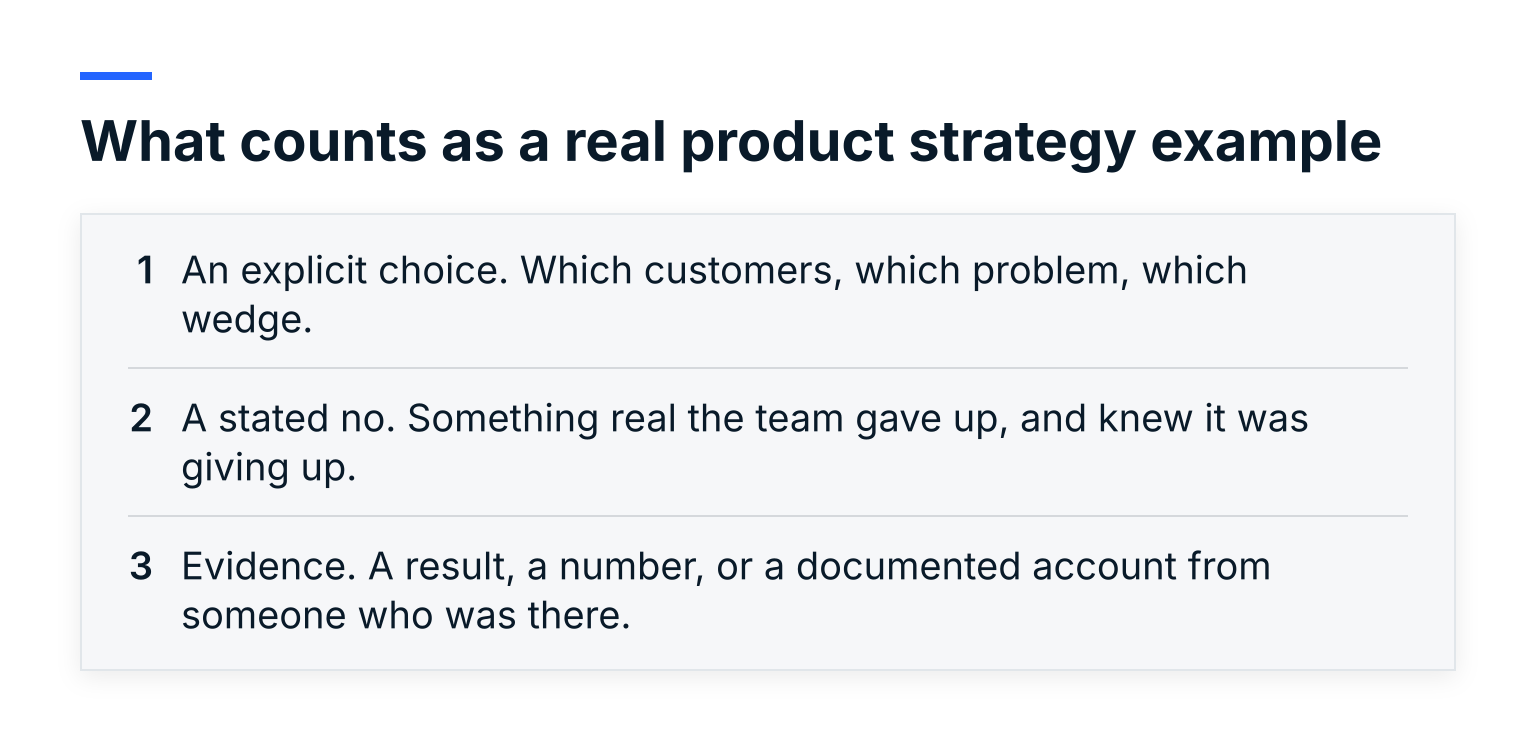
- 1.An explicit choice. Which customers, which problem, which wedge.
- 2.A stated no. Something real the team gave up, and knew it was giving up.
- 3.Evidence. A result, a number, or a documented account from someone who was there.
"Grow revenue 30%" is a goal. "Ship in 30 markets in 60 days and accept a messier product to beat a clone" is a strategy, because it forces a tradeoff. Most goals never come with a no attached.
Netflix: strategy found through experiments, not chosen upfront
Stage fit: pre-product-market fit, when your model is not working.
Netflix launched in April 1998 selling and renting DVDs online. In its first month it took in $100,000, and almost all of it came from selling DVDs, not renting them. Co-founder Marc Randolph has told this story many times: for about a year and a half, the team ran one failed experiment after another on the rental model. In his interview on The Tim Ferriss Show, he describes the real insight as building "this system and this process and this culture for testing lots of bad ideas."
The model that worked combined subscription with an idea from the warehouse: let customers keep DVDs as long as they wanted, with no due dates and no late fees. Randolph called it a "completely irrational combination of things" on paper, and it took off. Even then it nearly killed the company: with a free first month, every new signup cost about $50 up front, so Netflix was, in his words, "rapidly going broke becoming successful" (TheWrap interview).
What to copy: when your model is not working, the strategy is the experiment system, not any single idea. Also note what Netflix said no to: the rental-by-the-title model everyone assumed was the business.
Airbnb: strategy dictated by a funded copycat
Stage fit: scaling, when a well-funded competitor shows up.
In 2011, the Samwer brothers' Wimdu cloned Airbnb in Europe, reportedly raised about $100 million, and hired 400 people in 30 days across a string of international offices. Then came an ultimatum: buy us, or else. Brian Chesky refused, on the view that "in a war between missionaries and mercenaries, the missionaries always win", and chose to fight: raise aggressively and expand across Europe fast, accepting a messier product to hold the market. The full account is on Sequoia's Crucible Moments podcast.
Jonathan Golden, Airbnb's first product manager, described how the product team worked under this kind of pressure in First Round Review: teams were designed around outcomes, not features, and disbanded once the outcome was reached, because strategy dictated structure, not the other way around.
What to copy: in a marketplace, the network effect decides the winner, so speed can beat polish. The tradeoff Airbnb accepted was quality and culture risk. If your market is not winner-take-all, do not copy the blitz.
Slack: the staged beta as a strategy
Stage fit: scaling a team product with a long sales loop.
Slack's beta was not a bug-hunt; it was the feedback engine. The team used the product internally for months, then shared it with six to ten companies run by friends, then progressively larger groups. Stewart Butterfield explained the pattern in First Round Review: "The pattern was to share Slack with progressively larger groups." Each wave exposed problems the smaller waves had hidden.
Two deliberate choices stand out. First, they called the August 2013 launch a "preview release," not a beta, because asking a whole company to move its communications onto flaky software would have killed adoption. Second, they spent the beta teaching the market that team chat was a category at all, since 70 to 80% of early users said they used "nothing" for internal communication.
Years later, when growth plateaued in 2020, Slack's product leadership made a different kind of strategic call: stop optimizing hundreds of small experiments and rip up the entire first-day experience in a rebuild called Project Day One, as its CPO described in First Round Review. The honest lesson: strategies expire. The staged-beta strategy that built Slack did not solve the plateaued-funnel problem.
Stripe: the developer-ease bet and its cost
Stage fit: an early differentiator that starts to break as the market shifts.
Stripe's original bet was integration ease. The famous "seven lines of code" was most likely the length of the curl snippet a developer could run to make a live card charge, as Stripe's own engineering team recounts in "Stripe's payments APIs: The first 10 years". The real strategy was not the snippet. It was abstracting away payment complexity so a startup developer could accept payments in minutes, and betting that developers, not enterprise buyers, would drive adoption.
Then the world shifted toward new payment methods, and the simple Token/Charge model became the constraint. A small Stripe team locked itself in a conference room for three months to redesign the API around PaymentIntents and PaymentMethods. The redesign objectively made the simple US card integration harder. Stripe's answer was to package the API in two integrations so the easy card path stayed available, with a stated limitation: you cannot easily add new payment methods on it.
What to copy: name the tradeoff out loud. Stripe knew the redesign hurt its most eager users and built a bridge for them rather than pretending there was no cost.
TikTok: focusing a niche in zero-to-one
Stage fit: zero-to-one, after a failed idea.
Musical.ly, later rolled into TikTok, began as an education video app that was going nowhere. Co-founder Alex Zhu has told the pivot story publicly, including at #ProductSF in 2016. The team turned the failed idea into a narrow product: short music videos that teenagers could make and watch in seconds. By the time it was acquired in 2017 it had about 60 million monthly users.
The strategic choice was focus: a short-video niche for teens, not the broad social network it eventually became. The tradeoff was a small, unproven market at launch.
GitLab: publishing your strategy as a constraint
Stage fit: distributed teams, or any company whose roadmap keeps drifting.
GitLab is unusual in that its strategy is public. Its handbook states a 10-year vision and a three-year strategy built on named pillars (Customer Results, Maturing the Platform, Growing Careers), with the strategy revisited every year. Product leaders maintain public direction pages that connect investment to that strategy.
Why publish? Transparency is a value at GitLab, and the handbook doubles as a hiring and sales asset. But the more useful point for you is the discipline: a published strategy is harder to quietly abandon. If your team reopens the same priorities every quarter, a written strategy with explicit scope is the constraint.
Tesla: recursive strategy, or working backward
Stage fit: sequencing a long path with limited capital.
Elon Musk's 2006 Tesla "master plan" listed the steps: build a sports car, use that money to build an affordable car, use that money to build an even more affordable car, and provide zero-emission power options. Vinny Lingham called this pattern "recursive product strategy" in First Round Review: work back from a 5-to-10-year end goal until you find the first step you can actually take now.
The key move is the direction of design. You present the plan chronologically, but you design it recursively, backing into the opening move from the vision. Lingham applied the same method to his own company, Civic.
What to copy: if your vision is 10 years out, write the sequence with funding logic in it. Each stage should pay for or unlock the next.
What these examples share
| Example | The explicit choice | The stated no | The evidence it worked | Most relevant stage |
|---|---|---|---|---|
| Netflix | Subscription DVD rental, tested into existence | The per-title rental model | A year and a half of tests; the model took off | Pre-PMF |
| Airbnb | Fight the clone and expand fast | Selling to Wimdu | Account from Brian Chesky on Crucible Moments | Scaling under threat |
| Slack | Progressive feedback waves; teach the category | Calling it a beta | 15,000 sign-up requests in two weeks of preview | Scaling a team product |
| Stripe | Developer ease as the wedge | Simplicity for complex payment methods | Three-month API redesign; packaged bridge | Differentiator under strain |
| TikTok (Musical.ly) | Narrow teen niche | The original edtech idea | About 60M monthly users at acquisition | Zero-to-one |
| GitLab | Public, pillar-based 3-year strategy | Undocumented drift | Yearly strategy review in the handbook | Distributed, scaling |
| Tesla | Sequence backward from the vision | Anything not funding the next stage | Roadster to Model S to Model 3 as written | Long-horizon sequencing |
Three patterns recur across all seven:
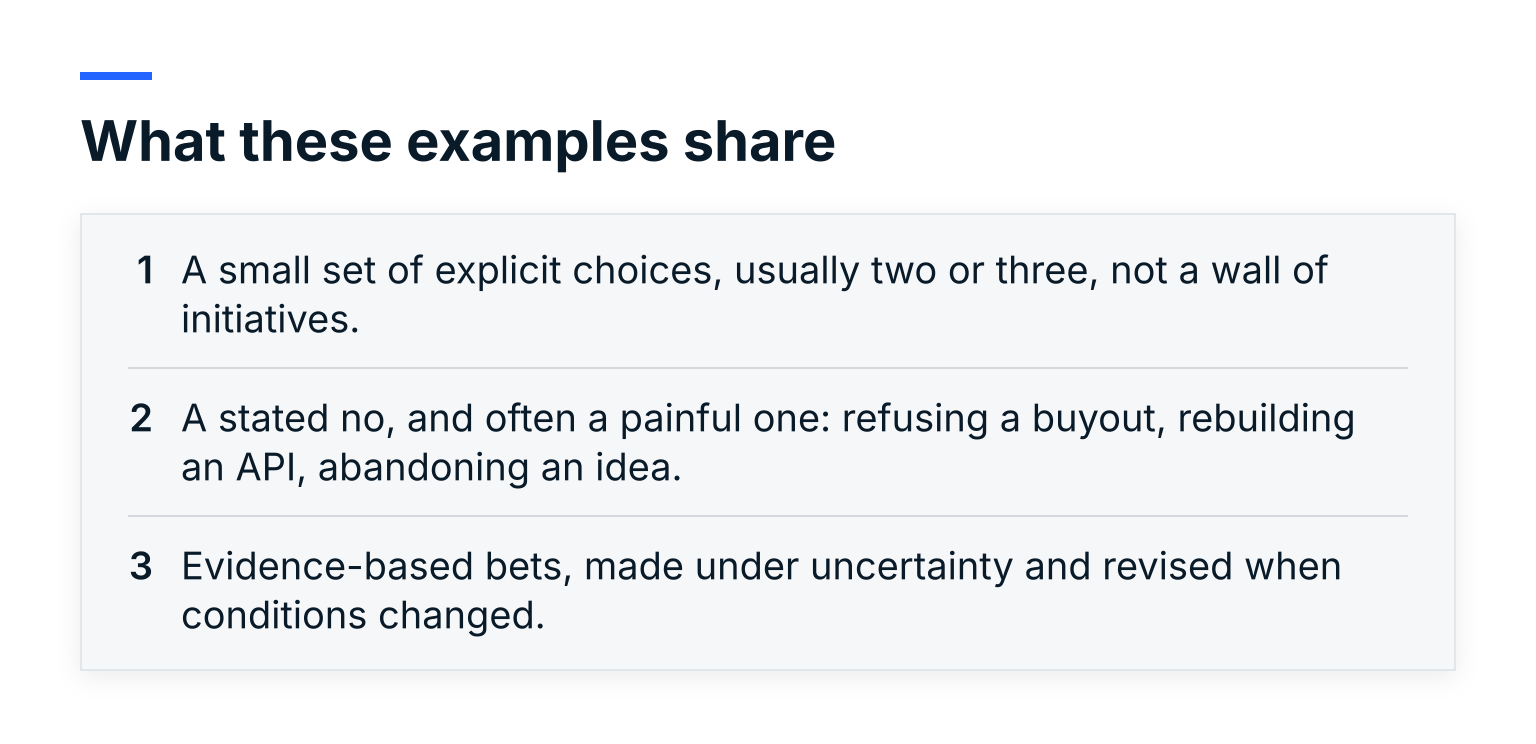
- 1.A small set of explicit choices, usually two or three, not a wall of initiatives.
- 2.A stated no, and often a painful one: refusing a buyout, rebuilding an API, abandoning an idea.
- 3.Evidence-based bets, made under uncertainty and revised when conditions changed.
To extract your own example, take one page and answer four questions, the same ones the cases above answer: Who do you serve and what do you win on? What are you deliberately not doing? What evidence would tell you the bet is working? What comes next if it is? For a fill-in structure, use the Product Strategy Template: A Simple Framework for Startups.
Three failure modes these examples help you avoid
Mistaking a KPI for strategy. "Grow ARR 40%" has no tradeoff, so it cannot guide a single decision. If your strategy document would still be true after a competitor pivots, it is not a strategy.
Strategies with no stated no. If every priority is a priority, your roadmap is a wish list. This is usually the real reason a roadmap keeps slipping: the no was never made explicit, so everything gets negotiated weekly.
Copying examples without stage context. Airbnb's blitz made sense for a marketplace with network effects under an existential threat. Running your B2B SaaS the same way would burn cash for nothing. Match the example to your stage, and when conditions keep changing, that is a signal to use a decision loop like The SHARP Loop rather than a fixed plan.
Your next step
Pick one example above that matches where your company is now. Write the choice, the no, and the evidence test for it on one page this week. If you would rather pressure-test that page with someone else, request a call to discuss product direction, prioritization and go-to-market, or Pitch SHARP fundraising prep.